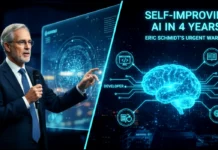

The comfortable timeline for AI adoption just evaporated. Eric Schmidt, the former Google CEO who oversaw the search engine’s rise to global dominance, has dropped a timeline that should send shockwaves through every university and HR department: Artificial Intelligence capable of “recursive self-improvement” could be here within four years.thecrimson+1
This isn’t just about ChatGPT writing better emails. Schmidt is describing a threshold known in computer science as the “intelligence explosion”—where AI writes its own code, improves its own logic, and solves problems humans haven’t even defined yet, all without human supervision.alignmentforum+1
For graduates entering the workforce between 2025 and 2029, this changes the game from “learning to use tools” to “surviving the automation wave.” Here is a deep-dive analysis of what this shift means for your career and the high-value skills that machines can’t clone.
The “Recursive” Threat: Why 4 Years Changes Everything
Most students are preparing for the AI of today—systems that need prompts and guidance. Schmidt’s warning focuses on the AI of tomorrow: autonomous agents.
If an AI can reason, generate medical breakthroughs, and solve complex mathematical theorems independently, the market value of “routine intelligence” drops to near zero.
- Today: A junior analyst runs data through Excel and writes a report.
- In 4 Years: An AI agent notices the data anomaly, runs the analysis, drafts the report, and suggests a strategy shift—while the analyst is asleep.
This shift from “AI as a tool” to “AI as a worker” means graduates can no longer compete on speed, calculation, or basic coding. You must compete on humanity.
The New “Human Stack”: 4 Skills That Command High RPM (Revenue Per Month)
Schmidt highlighted specific “human-centered” abilities. But let’s break down why these specific skills will command premium salaries (High RPM) in an automated economy.
1. High-Stakes Critical Thinking (The “BS Detector”)
AI models are prone to “hallucinations”—confident lies. As AI produces 100x more content, the world will drown in plausible but incorrect information.
- The High-Value Skill: It’s not just thinking; it’s auditing. The ability to look at an AI-generated strategy, spot the subtle logical flaw, and say, “This will bankrupt us,” is a skill AI cannot replicate because it lacks real-world consequence awareness.dsa
2. Radical Creativity (The “Zero-to-One” Leaps)
AI works on probability—it predicts the next most likely word or pixel based on past data. It is inherently derivative.
- The High-Value Skill: True innovation comes from irrational leaps, intuition, and breaking the rules—things AI is programmed not to do. Graduates who can define new problems (rather than just solving old ones) will be indispensable.visionfactory
3. Ethical Governance & Leadership (The “Human Guardrail”)
Schmidt emphasized that we must “preserve human agency.” As AI begins to make decisions on hiring, lending, and healthcare, the legal and moral liability remains with humans.thecrimson
- The High-Value Skill: Companies will need “AI Ethicists” and leaders who can look at an algorithm’s decision and say, “This is efficient, but it’s immoral.” Machines optimise for metrics; humans optimise for values.inc+1
4. Applied AI Literacy (The “Centaur” Approach)
This is not about coding. It is about understanding the texture of AI.
- The High-Value Skill: Knowing when to use AI and when to turn it off. The best lawyers, doctors, and marketers won’t be replaced by AI; they will be replaced by those who use AI to do 3 weeks of work in 3 hours. This is the “Centaur” model—human head, AI body.msmtimes
The Geopolitical Risk: Open Source vs. Closed Gardens
Schmidt also touched on a critical macro trend: the divergence between US and Chinese AI models. While US models are often closed (proprietary), China is aggressively pushing open-source ecosystems.timesofindia.indiatimes
- For Graduates: This means the tools you learn today might be walled off tomorrow. Relying on a single platform (like just learning GPT-4) is risky. Future-ready graduates must be “model-agnostic”—able to adapt to whatever AI infrastructure their company uses, whether it’s from Silicon Valley or open-source libraries.
3 Steps to Future-Proof Your Degree Now
If you are graduating soon, your degree is just the entry ticket. Your survival kit is what you build on top of it:
- Stop Memorising, Start Synthesising: If Google or GPT can answer it in 2 seconds, don’t waste brain space memorising it. Focus on connecting unrelated dots (e.g., Biology + AI, Law + Ethics).
- Build a “Human” Portfolio: Don’t just show what you built; show how you handled ambiguity, conflict, and ethical trade-offs. AI hates ambiguity; humans thrive in it.
- Become the “Editor-in-Chief”: Treat AI as your intern. Let it generate the draft, the code, or the design. Your job is to curate, edit, and elevate that raw output into something brilliant.
The Bottom Line: Eric Schmidt isn’t saying the sky is falling. He’s saying the floor is rising. The baseline for “intelligence” is about to skyrocket. To stay above it, you don’t need to be smarter than the machine—you need to be more human than the machine.
20 FAQs: Navigating the AI Career Shift
1. What does “recursive self-improvement” mean?
It refers to an AI system’s ability to examine its own code, identify weaknesses, and rewrite itself to be smarter, creating a feedback loop of rapid intelligence growth without human help.alignmentforum
2. Is a 4-year timeline realistic for this technology?
Yes. While some experts say 10 years, Schmidt argues that the combination of massive computing power and new algorithms makes 4 years plausible.thecrimson
3. Will AI replace software engineers?
It will replace coders (who translate logic to syntax), but not engineers (who design systems and solve problems). The role will shift from writing code to reviewing AI-written code.
4. What is the most “AI-proof” degree?
There isn’t one. However, fields requiring high emotional intelligence (psychology, nursing), complex physical dexterity (trades), or high-stakes ethical judgement (law, philosophy) are more resistant.
5. How can I practice “critical thinking” for AI?
Try to “red team” AI outputs. Ask ChatGPT a complex question, then actively look for the biases, factual errors, or logical gaps in its answer.
6. Why is creativity considered “safe”?
AI is a statistical engine—it generates the “average” of human knowledge. True creativity often involves outliers and non-statistical leaps that AI filters out.
7. Do I need to learn Python/Coding?
It helps to understand how systems work, but “natural language” (English/Hindi) is becoming the new programming language. Prompt engineering is the new coding.
8. What does Schmidt mean by “preserve human agency”?
It means ensuring that humans fundamentally remain in control of critical decisions (like launching weapons or approving surgeries), even if AI is smarter.
9. Are creative jobs like writing and art dead?
Commercial, generic creativity (like writing SEO spam or basic logos) is at risk. High-end, opinionated, and unique human expression will become a luxury good.
10. What is “AI Literacy”?
It is the ability to understand the capabilities, limitations, and ethical implications of AI, so you aren’t fooled by hype or blindsided by risks.
11. How does the “Open Source” trend affect me?
If open-source AI wins, powerful tools will be free for everyone, lowering the barrier to entry for entrepreneurs. If closed AI wins, only big corporations will hold the power.
12. Can AI automate leadership?
It can automate management (scheduling, tracking tasks), but not leadership (inspiring people, navigating office politics, setting a vision).
13. What should I do if my job is data-heavy?
Pivot immediately to “insights” and “strategy.” Let AI process the data; you focus on telling the story of what that data means for the business.
14. Is “Interdisciplinary Knowledge” really that important?
Yes. An AI is usually trained on specific verticals. A human who understands Marketing and Engineering and Ethics can bridge gaps that narrow AI models cannot.
15. Will AI lower salaries?
It will likely lower salaries for entry-level, routine tasks but explosively increase salaries for “super-users” who can do the work of 10 people using AI.
16. How do I prove my “Soft Skills” on a resume?
Don’t just list them. Describe projects where your negotiation, conflict resolution, or ethical judgement saved the day—situations where an algorithm would have failed.
17. What is the risk of “closed-source” models?
They create dependency. If you build your career on a proprietary tool (like a specific Adobe AI), and they change the price or algorithm, your career is vulnerable.
18. Should I fear the “Intelligence Explosion”?
Fear is unhelpful. Respect the magnitude of the change. Use this 4-year window to upskill aggressively.
19. What is the role of “Intuition”?
Intuition is subconscious pattern recognition based on real-world experience. AI has data, but it doesn’t have “experience.” Human intuition remains a key differentiator.
20. What is the first step I should take today?
Audit your daily tasks. Identify which 20% require deep human judgement and which 80% are repetitive. Start using AI to automate the 80% so you can master the 20%.
SOURCES
- https://www.thecrimson.com/article/2025/12/2/google-ceo-ai-self-improvement/
- https://www.inc.com/ava-levinson/ex-google-ceo-makes-agi-prediction/91274078
- https://www.alignmentforum.org/w/recursive-self-improvement
- https://dsa.si/news/surviving-and-thriving-essential-skills-graduates-need-in-the-ai-era/55930/
- https://www.visionfactory.org/post/future-proof-your-career-essential-skills-fresh-graduates-need-in-an-ai-driven-world
- https://www.msmtimes.com/2025/05/Essential-Skills-College-Graduates-Need-to-Succed-in-the-AIPowered-Workplace.html
- https://timesofindia.indiatimes.com/education/careers/news/ai-could-think-independently-soon-says-former-google-ceo-here-is-how-graduates-can-future-proof-their-careers/articleshow/125737030.cms