


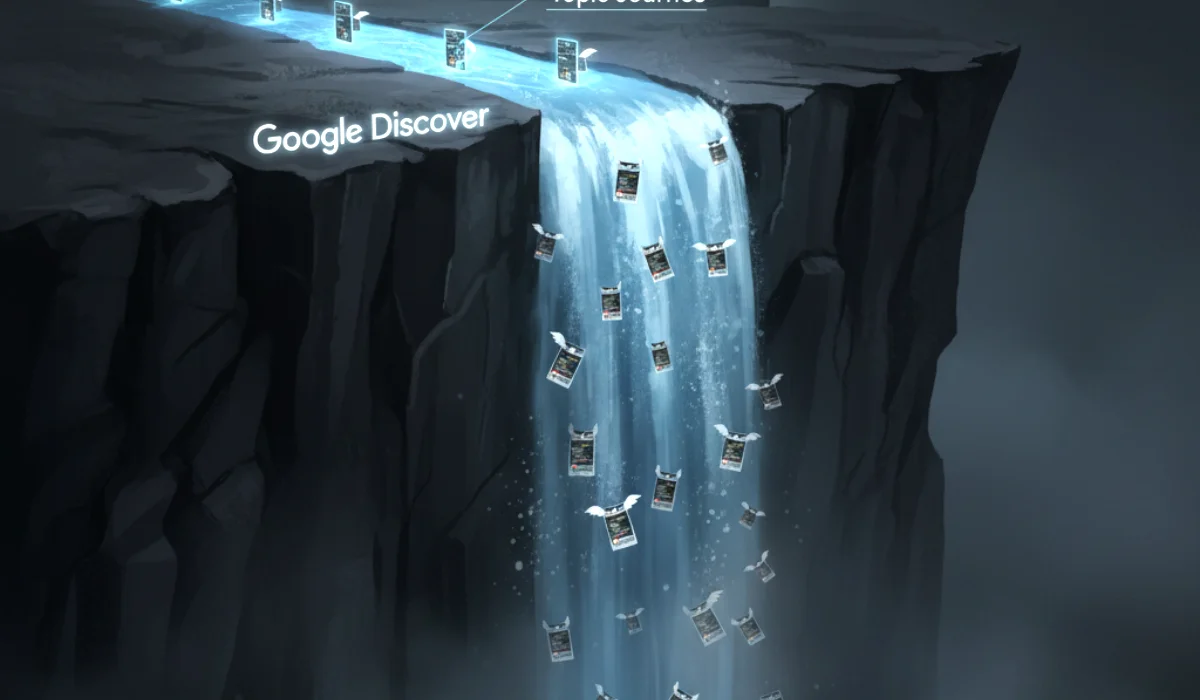
Publishers and content creators who once feasted on a steady stream of traffic from Google Discover are waking up to find their numbers have fallen off a cliff. There has been no official Google announcement, no blog post, no warning. But a dramatic, unconfirmed shift in the Discover algorithm is underway, and the chatter among SEO experts is so consistent, it might as well be a leak.
This isn’t a minor tweak. This is a fundamental change in how Google perceives and ranks content for its 800 million users. The old rules are dead. Clickbait headlines, shocking images, and one-hit-wonder viral articles are no longer working.
A new, smarter AI is in charge, and it’s not just looking at a single article. It’s looking at the user’s entire journey. Welcome to the era of the “Journey Algorithm.”
Expert Analysis: “As a consultant who analyzes traffic patterns for dozens of major sites, I can tell you this isn’t speculation. We are seeing a clear and consistent pivot away from rewarding individual ‘viral’ articles towards rewarding comprehensive ‘topic journeys.’ The new Discover AI isn’t asking, ‘Which article will this user click on?’ It’s asking, ‘Which website can I trust to guide this user through their entire learning process on a subject?’ If your site can’t answer that second question, you are now invisible to Discover.”
What SEO Experts Are Seeing: The Five Pillars of the New Discover Algorithm
While there is no leaked document, the community’s collective data points paint a clear picture of the new rules of the game.
1. The Death of the ‘One-Hit Wonder’
The old Discover algorithm would often pick up a single, highly engaging article from a site and send it millions of views, even if the rest of the site was mediocre.
- What We’re Seeing Now: This is no longer happening. The new algorithm is ignoring individual articles and instead favoring websites that have built deep, interconnected topic clusters. It’s looking for sites that have 10, 20, or even 50 articles covering every facet of a single subject. One great article on “AI” is now useless if it’s not supported by a library of content on related topics.
2. The Rise of the ‘Journey Score’
This is the most critical change. The algorithm is now tracking user behavior across multiple articles to calculate a “Journey Score.”
- How it Works: If a user reads your article about “What is AI?”, and then immediately reads your next article about “How do AI models learn?”, your site’s “Journey Score” for that user on the topic of AI increases. If they go on to read a third article from you on AI cybersecurity, you essentially become their “trusted guide” on the topic. Google will then be far more likely to show that user more of your content in the future.
3. ‘Next Step’ Content is King
Because the algorithm is trying to build a journey, it is now actively prioritizing content that serves as the logical “next step” for the user.
- How to Win: You must stop thinking in terms of individual articles and start thinking like a course creator. Map out your content in logical sequences.
- Article 1: What is AI? (The Problem)
- Article 2: How Does AI Work? (The Explanation)
- Article 3: How to Use AI in Your Job (The Solution)
- Article 4: The Future of AI in the Workplace (The Implications)
4. Hyper-Specific Author Authority
The concept of E-E-A-T (Experience, Expertise, Authoritativeness, Trustworthiness) is now being applied with surgical precision. It’s not enough for your website to have authority; the author must have demonstrated expertise in a specific niche.
- What We’re Seeing Now: Authors who consistently write about a single topic are seeing their content prioritized. An author with 30 articles on digital marketing is now seen as a more trusted entity for a marketing-related query than a generalist writer on a large news site. Clear author bios, bylines, and dedicated author pages are more critical than ever.
5. The ‘Utility Score’ Is Crushing Clickbait
The AI has finally gotten smart enough to distinguish between a headline that makes a big promise and an article that actually delivers.
- What Works Now: Content with high “Utility”—articles that solve a specific problem. This includes in-depth guides, articles with checklists (like a data breach detection framework), templates, and tutorials. The algorithm can identify when users are actively using the content, not just reading and leaving.
Conclusion: Stop Chasing Clicks, Start Building Journeys
The unofficial leak of the “Journey Algorithm” marks the end of an era. The days of gaming Google Discover with a catchy headline and a shocking image are over. The new algorithm is playing a long-term game, and it expects you to do the same.
Success on Google Discover in 2025 and beyond will not be about winning a single click. It will be about earning the user’s trust over an entire session, guiding them from one piece of expert content to the next. Stop writing articles. Start building libraries. Stop chasing viral hits. Start creating educational journeys. The AI is looking for guides, not just clickbait.
Frequently Asked Questions (FAQs)
1. Is there a real Google Discover algorithm leak?
No, there is no official leaked document. The term “leak” refers to the fact that SEO experts and publishers are all observing the same dramatic, unannounced changes in how the algorithm behaves, leading to a strong community consensus on the new ranking factors.
2. Why did my Google Discover traffic suddenly drop?
It’s likely because your site relies on individual viral articles rather than deep, interconnected topic clusters. The new “Journey Algorithm” is deprioritizing sites that can’t serve as a comprehensive guide on a specific subject.
3. Is clickbait dead on Google Discover?
Mostly, yes. While a catchy headline is still important, the algorithm is now better at identifying when the content doesn’t deliver on the headline’s promise. Content with high “utility” is now heavily favored over simple clickbait.
4. What are “Topic Clusters”?
A topic cluster is a content strategy where you create a main “pillar” article on a broad subject (e.g., “AI for Beginners”) and then create many smaller, more specific articles on related sub-topics (e.g., “What is a Large Language Model?”, “How to use ChatGPT”) that all link back to the pillar page.
5. How do I create “Next Step” content?
Anticipate your reader’s next question. If your article is about “The Problem,” your next article should be about “The Solution.” Think of your content as a sequence, guiding the user through a topic step-by-step.
6. Does author authority really matter?
More than ever. The new algorithm appears to be tracking the topical focus of individual authors. An author who writes exclusively about a single niche will be seen as more authoritative on that topic than a generalist writer.
7. How can I improve my “Journey Score”?
Build deep content libraries around specific topics and use strong internal linking to guide users from one related article to the next, keeping them on your site for longer.
8. Should I delete my old articles?
No. Instead, update and group them. Consolidate thin articles and organize your existing content into logical topic clusters.
9. Are images and videos still important for Discover?
Yes, a compelling main image is still crucial for the initial click. However, it’s no longer enough on its own. The underlying content journey is now the primary ranking factor.
10. How long does an article need to be?
There is no magic number. The length should be appropriate for the topic. A simple definition might be 500 words, while a comprehensive guide might be 5,000 words. The key is comprehensiveness, not just word count.
11. Is this change related to Google’s E-E-A-T guidelines?
Yes, this is the ultimate expression of E-E-A-T. The algorithm is rewarding sites that demonstrate true Expertise, Authoritativeness, and Trustworthiness by providing comprehensive, interconnected content journeys.
12. Why is my Discover traffic so volatile?
Volatility is often a sign that you are ranking for individual “one-hit wonder” articles. To stabilize your traffic, you need to build the topical authority that makes your entire site, not just one article, a trusted source for Discover.
13. Does this affect regular Google Search rankings?
Yes, the principles are the same. Building topic clusters and demonstrating E-E-A-T are best practices for both Discover and regular Search SEO. This update just makes it more explicit for Discover.
14. How long does it take to see results from this new strategy?
Building deep topic clusters takes time. This is a long-term strategy. You should expect it to take 3-6 months of consistent, high-quality content production to start seeing results.
15. What tools can I use to plan topic clusters?
You can use SEO tools like Ahrefs, Semrush, or even Google’s own Keyword Planner to find related sub-topics and questions that people are asking about your main subject.
16. Is Google Discover the same as Google News?
No. Google News features timely, news-related content. Google Discover features more evergreen, interest-based content. This algorithm update primarily affects Google Discover.
17. How do I check if my author is being recognized by Google?
Ensure your articles have clear bylines that link to a detailed author page. Use structured data (Schema markup) for the author to explicitly tell Google who wrote the content.
18. Should I focus on one niche or multiple niches?
This update heavily favors a deep focus on one or two core niches rather than a broad, shallow approach to many different topics.
19. My site is new. Can I still get on Discover?
Yes, but it will be harder. Your path is to pick a very specific niche and build out a comprehensive topic cluster from day one. You can’t rely on a lucky viral hit anymore.
20. What is the number one thing I should do right now?
Conduct a content audit. Identify your strongest topic, find all your existing articles related to it, and start organizing them into a logical cluster with a central pillar page. This is the foundation of the new “Journey Algorithm” strategy.


