


If you’re a publisher or content creator, you’ve felt the cold dread. You wake up, check your analytics, and see a catastrophic nosedive in your Google Discover and News traffic. The flood of visitors you relied on has slowed to a trickle, and you have no idea why.
You’re not alone. Thousands of site owners are desperately searching for answers, but the common advice you’re hearing is likely wrong. This isn’t just about a single algorithm update. Your traffic didn’t just “drop”; it was taken from you.
The reality is that Google’s AI has become a ruthless gatekeeper of quality, and it’s no longer just penalizing bad content. It’s actively demoting average content. The causes are deeper and more systemic than a simple algorithm tweak, and they represent a permanent shift in how Google evaluates trust.
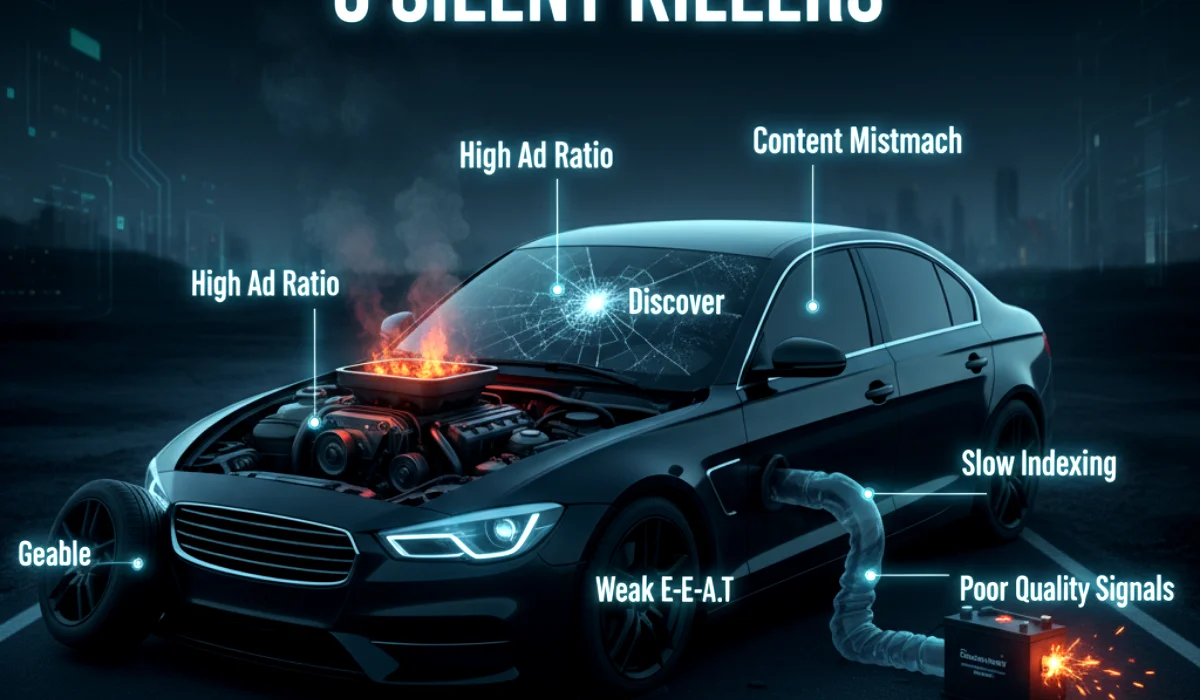
This is the definitive guide to the five “silent killers” that are actually responsible for your traffic collapse and the concrete steps you need to take right now to survive.
Expert Analysis: “The recent traffic bloodbath isn’t a bug; it’s a feature. Google is intentionally purging its feeds of what it deems ‘mid-level’ content. We’ve moved past the era of simple penalties. The new AI is looking at a holistic ‘Quality Signal Score’ for your entire domain. If you fail on one of the core pillars—like ad layout or author credibility—it can trigger a cascade failure that gets your entire site demoted from the Discover feed. The game has changed from ‘don’t be bad’ to ‘be exceptional, or be invisible.'”
The 5 Silent Killers of Your Google Traffic
Forget the surface-level chatter. These are the five core issues that SEO experts are actually seeing behind the massive traffic drops.
1. The E-E-A-T Signal Collapse
For years, E-E-A-T (Experience, Expertise, Authoritativeness, Trustworthiness) was a box you could check. Now, it’s a complex, multi-layered signal that Google’s AI is scrutinizing with terrifying precision.
- The Real Cause: The flood of generic, AI-generated content has made real expertise a rare and valuable commodity. Google is no longer just looking for an author bio. It’s looking for hyper-specific author authority. An author who has written 50 articles on “cybersecurity” is now trusted far more than a general news site that publishes one article on the topic. If your site lacks deep, proven expertise in a single niche, your E-E-A-T score has collapsed. This aligns perfectly with the shift to the “Journey Algorithm” which rewards trusted guides.
- How to Fix It: Double down on a single niche. Cultivate real authors with proven track records and give them prominent, detailed author pages. Stop being a generalist. Start being a specialist. Your goal is to own a topic, not just report on it.
2. The ‘Ad-to-Content Ratio’ Bomb
Your ad layout is no longer just a user experience issue; it’s a primary ranking factor.
- The Real Cause: Google’s AI is now performing sophisticated page layout analysis. It can see how much of the screen is taken up by ads, pop-ups, and subscription boxes “above the fold” (the part of the screen visible without scrolling). If the ad-to-content ratio is too high, especially on mobile, the AI flags your site as having a poor user experience and will suppress its visibility in Discover.
- How to Fix It: Conduct a ruthless audit of your ad layout. Remove intrusive pop-ups and video players. Ensure that at least 60-70% of the initial screen on mobile is pure content. A slight drop in ad revenue is better than a total loss of traffic.
3. The “Slow Indexing” Plague
Are your new articles taking days or even weeks to get indexed? This isn’t a bug; you are being intentionally throttled.
- The Real Cause: The internet is being flooded with billions of low-quality, AI-generated articles. Google’s crawlers are overwhelmed. To cope, they are now operating a triage system. If Google’s AI has flagged your site as low-to-medium quality (due to the other issues on this list), it will place you in a low-priority crawl queue. Your content is no longer considered important enough to index immediately. This is a direct consequence of the AI spam problem.
- How to Fix It: The only fix is to drastically improve your overall site quality. Focus on publishing fewer, but significantly better, articles. Go back and improve or delete your old, thin content. You need to prove to Google that your site is a high-signal source worth crawling frequently.
4. The Content Mismatch Penalty
The classic clickbait tactic of using a shocking headline or image that doesn’t match the article’s content is now being actively punished.
- The Real Cause: Google’s AI can now perform advanced semantic and image analysis to determine if your headline and featured image are a true and accurate representation of your content. If a user clicks your article about a “shocking celebrity event” and the article is just a generic summary, the AI registers this as a “trust violation.” Rack up enough of these violations, and your entire domain gets a penalty.
- How to Fix It: Be honest. Your headline and image must be a direct and accurate promise of the content to come. The short-term click is not worth the long-term domain penalty. Focus on creating content with high readability and utility.
5. The ‘Quality Signal’ Death Spiral
This isn’t a single issue but a cascade failure caused by a combination of smaller technical problems.
- The Real Cause: Your site’s “Quality Signal” is a holistic score based on hundreds of factors. A drop in one area can trigger a “death spiral.” For example, a slightly slower site speed leads to a higher bounce rate. A higher bounce rate signals a poor user experience. This, combined with a high ad ratio and weak E-E-A-T, tells Google’s AI that your site is low quality, leading to slow indexing and a total drop from Discover.
- How to Fix It: Treat technical SEO as a top priority. Aggressively optimize your Core Web Vitals. Ensure your mobile site is flawless. Minify your CSS and JavaScript. This is no longer optional; it’s a matter of survival.
Conclusion: The Age of ‘Good Enough’ is Over
The painful truth is that the era of easy traffic from Google is over. The bar has been raised, and “good enough” is no longer good enough. Google is now actively rewarding exceptionalism and punishing mediocrity.
You cannot fix your traffic drop with a single trick or a minor adjustment. It requires a fundamental, top-to-bottom commitment to quality, user experience, and genuine expertise. The choice is simple: evolve into a high-quality, specialized resource, or prepare to be permanently left behind.
Frequently Asked Questions (FAQs)
1. Why is my Google Discover traffic zero all of a sudden?
This is often the result of a site-wide quality penalty. Your site has likely triggered multiple “silent killer” flags (poor E-E-A-T, high ad ratio, content mismatch), causing Google’s AI to remove your entire domain from the Discover feed.
2. How long does a Google penalty last?
There is no set time. Recovery depends on how quickly and thoroughly you fix the core quality issues on your site. For a deep-seated E-E-A-T problem, it could take 6-12 months of consistent effort to regain Google’s trust.
3. Is Google de-indexing my site?
Probably not completely. It’s more likely that you’ve been placed in a “slow indexing” queue. Your most important pages will likely remain indexed, but new content will be crawled and indexed very slowly until your overall quality score improves.
4. Can too many ads really kill my traffic?
Yes, absolutely. An aggressive ad layout that harms the user experience is now a major negative ranking factor for both Discover and Search.
5. How do I know if my E-E-A-T is weak?
Ask yourself: Does my site have a clear, focused niche? Are my authors recognized experts in that niche? Is my content generic, or does it offer unique insights and experience? If the answer is no to any of these, your E-E-A-T is likely weak.
6. Will buying more backlinks fix this problem?
No. This is not a classic authority problem that can be fixed with backlinks. This is a deep, on-site quality and trust issue.
7. Should I just start a new website?
This is a last resort. It’s better to fix your existing site, as a new site will start with zero authority and will face the same intense quality scrutiny.
8. How can I check my “Ad-to-Content Ratio”?
View your own site on a standard mobile device. If ads, pop-ups, and cookie banners take up more than 30-40% of the initial screen, your ratio is likely too high.
9. Why is Google being so strict now?
Because the web is flooded with low-quality, AI-generated content. Google is being forced to become extremely strict to filter out the noise and provide a good user experience.
10. Is AI-generated content always bad for SEO?
Not necessarily, but it is very difficult to create high-quality evergreen content with AI that demonstrates unique experience and expertise. Over-reliance on AI is a major contributor to weak E-E-A-T signals.
11. What are Core Web Vitals?
They are a set of metrics Google uses to measure a site’s technical performance and user experience, including loading speed (LCP), interactivity (INP), and visual stability (CLS).
12. How do I improve my author’s authority?
Have them write exclusively on one topic. Get them featured on other reputable sites in your niche. Ensure their author bio on your site is detailed and links to their social media or professional profiles.
13. Does changing my theme or design help?
Only if the new theme is faster, more mobile-friendly, and allows for a better ad-to-content ratio. A simple cosmetic change will not help.
14. What is a “trust violation”?
In this context, it’s when your headline and featured image make a promise that your content does not fulfill. It breaks the trust between the user, your site, and Google.
15. Could a technical issue like a server error cause this?
A major, prolonged technical issue can certainly cause a traffic drop, but the systemic, long-term suppression most sites are seeing is related to these deeper quality issues, not a simple bug.
16. How important is internal linking now?
It is critically important. Strong internal linking helps create the “topic clusters” and “user journeys” that the new algorithm is designed to reward.
17. I run a news site. How can I specialize in a niche?
Even on a news site, you can create dedicated “desks” or sections that go deep on specific topics (e.g., AI Policy, Cybersecurity, Green Energy). Make these sections the most comprehensive resource available.
18. What is the number one priority to fix?
Start with a content audit. Be honest with yourself. Is your content truly expert-level, or is it generic? Improving your E-E-A-T is the most important and most difficult part of the recovery process.
19. My site speed is good. Why did my traffic still drop?
Site speed is just one part of the “Quality Signal Score.” You could have perfect technicals, but if your E-E-A-T is weak and your ad ratio is high, you will still be demoted.
20. Is traffic from Google Discover gone for good?
No, but the easy traffic is gone for good. The only way back is to earn it by becoming an exceptional, high-quality resource that Google can trust to guide its users.


