


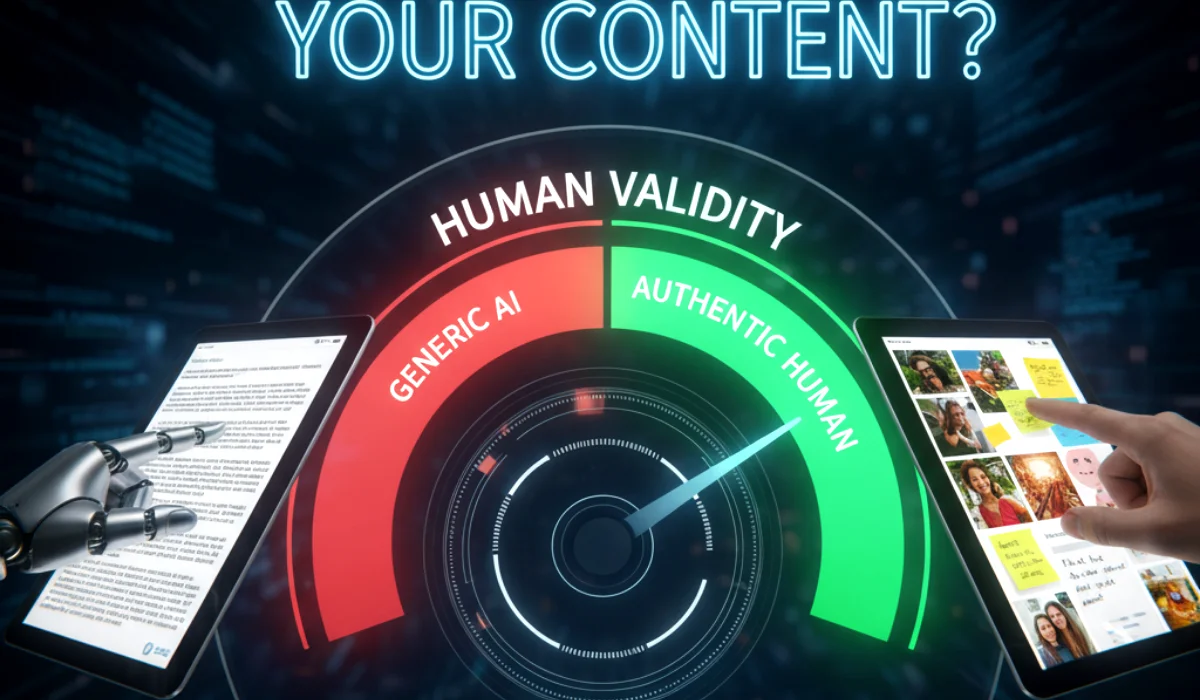
It’s the ivisible metric that’s quietly deciding the fate of millions of articles online. In mid-2025, without any official announcement, Google began using a new, sophisticated signal to evaluate AI-assisted content. SEO experts are calling it the “Human Validity Score.”
This isn’t another “AI detector.” Google knows that’s a losing game. Instead, it has developed something far more intelligent: a holistic score that measures the authenticity, experience, and human-like uniqueness of your content.
If your site’s traffic has fallen, it’s not because Google “detected” you used AI. It’s because your content failed the Human Validity test. It was flagged as being generic, unoriginal, and lacking a human soul.
This guide breaks down what the Human Validity Score is, how Google’s AI calculates it, and—most importantly—how to ensure your content passes the test.
Expert Analysis: “The Human Validity Score is the final piece of the E-E-A-T puzzle. It’s Google’s algorithmic solution to the ‘Experience’ problem. For years, AI could fake Expertise, Authority, and Trust, but it could never fake having lived a life. This new signal is a ‘proof of experience’ test. It analyzes the subtle linguistic fingerprints of your writing to determine if it was crafted by a human with real-world knowledge or assembled by a machine that has only ever read other articles. If your content lacks a unique human fingerprint, it will have a low Validity Score and will be suppressed.”
How Google Calculates Your Human Validity Score
This isn’t magic; it’s advanced pattern recognition. The score is a composite of several key signals.
1. Differentiating Human vs. AI Language Patterns
Human writing is inherently flawed and unique. AI writing, by default, is smooth and predictable.
- How it Works: Google’s AI analyzes your content for its “linguistic fingerprint.” Humans have unique vocabularies, grammatical quirks, and a tendency to use analogies and personal anecdotes. Generic AI content often has a very uniform sentence structure and relies on a predictable set of transition words. Content that is too “perfect” is a red flag.
- The Bottom Line: A low score is assigned to content that lacks a distinct, consistent authorial voice.
2. Authorship Consistency and Topical History
The score is tied to the author, not just the article.
- How it Works: Google’s AI looks at everything an author has written. Does this new article sound like their previous work? Does it align with their established topical expertise? If an author who has only ever written about finance suddenly publishes an “expert” article on quantum physics with a completely different tone, the AI flags this inconsistency, lowering the author’s validity score.
- The Bottom Line: This is why it’s critical not to be a generalist. Deep, consistent focus in one niche builds a high validity score for that author.
3. The “Experience” and “Information Gain” Check
This is the most important test. Does your content add new value to the internet?
- How it Works: The AI compares your article to the top existing content for that topic. If your article is just a slightly rephrased summary of what’s already out there—a common output of basic AI prompts—it fails the “Information Gain” test. The system is specifically looking for unique data, original research, a personal case study, or a first-hand account that only a human with real experience could provide.
- The Bottom Line: This is the core reason Google is punishing low-quality AI content. It’s not about the tool; it’s about the lack of new value.
4. The ‘High-Risk Signal’ Audit
The AI is trained to spot the classic signs of low-effort content farming.
- How it Works: A high density of stock photos, a lack of external links to credible sources, and a generic, uninspired headline are all “high-risk signals.” These are often combined with other factors, like a poor ad-to-content ratio, which can lead to a sudden Discover traffic drop.
- The Bottom Line: If your site looks like a low-quality content farm, the AI will assume it is one and assign it a low Human Validity Score across the board.
How to Improve Your Site’s Human Validity Score
You can use AI and still achieve a high score. The key is to use AI as an assistant, not as the author.
1. Inject Your “Human Spark”:
The first draft can come from an AI, but the final product must come from you. Go through every sentence and add your unique voice. Most importantly, add the “I.” Include personal stories, anecdotes, and opinions. Example: “I tried this, and here’s the one mistake I made that you should avoid.”
2. Show, Don’t Just Tell:
Instead of saying, “This tool is effective,” show how you used it. Include your own screenshots, your own videos, and your own data. This is undeniable proof of first-hand experience.
3. Become a Niche Authority:
Have your authors focus exclusively on one or two core topics. This builds a consistent, predictable “authorship fingerprint” that Google’s AI can learn to trust. Avoid being a generalist at all costs. This is also key for passing the automated trust audit for Google News approval.
4. Use AI for Structure, Not Substance:
Use AI to brainstorm ideas, create outlines, and improve the grammar and readability of your writing. But the core substance—the arguments, the data, the conclusions—must be driven by human expertise. This ensures your content passes the real-time quality validation that happens after a user clicks.
Conclusion: Authenticity is the New SEO
The Human Validity Score is Google’s elegant solution to the AI spam crisis. It’s a system that rewards what has always been at the heart of good content: authenticity, effort, and genuine human experience.
Stop worrying about “AI detection.” It’s a myth. Instead, obsess over your content’s authenticity. Does it sound like a real person wrote it? Does it share something new and valuable with the world?
In 2025, the most important ranking factor is not a keyword or a backlink. It’s your humanity.
Frequently Asked Questions (FAQs)
1. Is the “Human Validity Score” a real, confirmed metric from Google?
No. It is an unofficial term used by SEO experts to describe a new set of AI-driven quality signals Google is using to evaluate content authenticity and experience.
2. How is this different from E-E-A-T?
It is the algorithmic enforcement of the “Experience” part of E-E-A-T. It’s how Google’s machines measure the “humanness” and first-hand knowledge that was previously a more abstract concept.
3. Can AI content still rank in 2025?
Yes, absolutely—if it has been significantly edited and enriched by a human expert to have a high Human Validity Score. Raw, unedited AI output will not rank for competitive topics.
4. What is the biggest mistake that lowers the Human Validity Score?
Publishing content that lacks any personal stories, unique data, or first-hand anecdotes. This is the clearest signal that a human with real experience was not involved.
5. Does my author’s writing style matter?
Yes, consistency is key. If an author suddenly changes their tone, vocabulary, and sentence structure, it can be flagged as an authorship inconsistency, which may lower their validity score.
6. Will disclosing that I use AI help my score?
No. Disclosure is good for transparency, but Google ranks content on its quality, not on a disclosure tag. A low-quality article is still low-quality, even if you admit it was written by AI.
7. How can I measure my site’s Human Validity Score?
You can’t. It’s an internal Google metric. The best proxy is to be honest with yourself: does your content read like it was written by a passionate expert or a boring robot?
8. What is a “linguistic fingerprint”?
It’s the unique combination of vocabulary, grammar, rhythm, and sentence structure that every human writer has. It’s like a signature in your prose. AI-generated text often lacks this unique fingerprint.
9. Can I use AI to write my author bio?
It’s not recommended. Your author bio is a key place to demonstrate real, human experience and build trust. It should be written with a personal touch.
10. Why do some AI articles still rank?
They might be in a non-competitive niche, they may have been heavily edited by a human, or the algorithm just hasn’t demoted them yet. It is not a sustainable long-term strategy.
11. Is it better to use AI to rewrite my own ideas or generate new ones?
It’s much better to use AI to help outline and structure your own unique ideas and experiences.
12. Does this affect all types of content?
It is most important for “YMYL” (Your Money, Your Life) topics where experience and trust are critical. It is less important for more factual content like product descriptions or simple definitions.
13. How can I add “experience” to a topic I haven’t personally experienced?
You can feature quotes from true experts, conduct original surveys and present the data, or create in-depth case studies of others. You are adding value through original research, not just first-hand experience.
14. My content is very technical and data-driven. Does it still need a “human spark”?
Yes. Even technical content benefits from a clear, authoritative voice. You can add your own analysis of the data or explain how you would apply this technical knowledge in a real-world scenario.
15. Is this related to why new sites sometimes go viral?
Indirectly. A new site can sometimes go viral by creating content on a new topic with a very unique, human voice that instantly resonates with users, giving it a high initial Human Validity Score for that niche.
16. I’m a good writer. Can I just edit the AI content for grammar?
No, that’s not enough. You need to rewrite it to add your unique voice, perspective, and, most importantly, your personal experiences.
17. What’s the best way to use an AI writing assistant?
Use it as a research assistant to summarize sources, an outliner to structure your thoughts, and a sparring partner to brainstorm ideas. The human must always be the final author.
18. Does this mean I have to write all my content from scratch?
No. It means the final product must be indistinguishable from content written from scratch by a human expert.
19. Will Google ever be able to perfectly detect AI?
Probably not, and it doesn’t need to. It only needs to be able to detect “unhelpful,” “unoriginal,” and “inexperienced” content, and it is already exceptionally good at that.
20. What is the one thing I should do today to improve my score?
Go to your top 5 articles. Read them out loud. Do they sound like a real, passionate person, or do they sound like a Wikipedia article? If it’s the latter, rewrite the introduction to include a personal story or a bold, unique opinion.


