


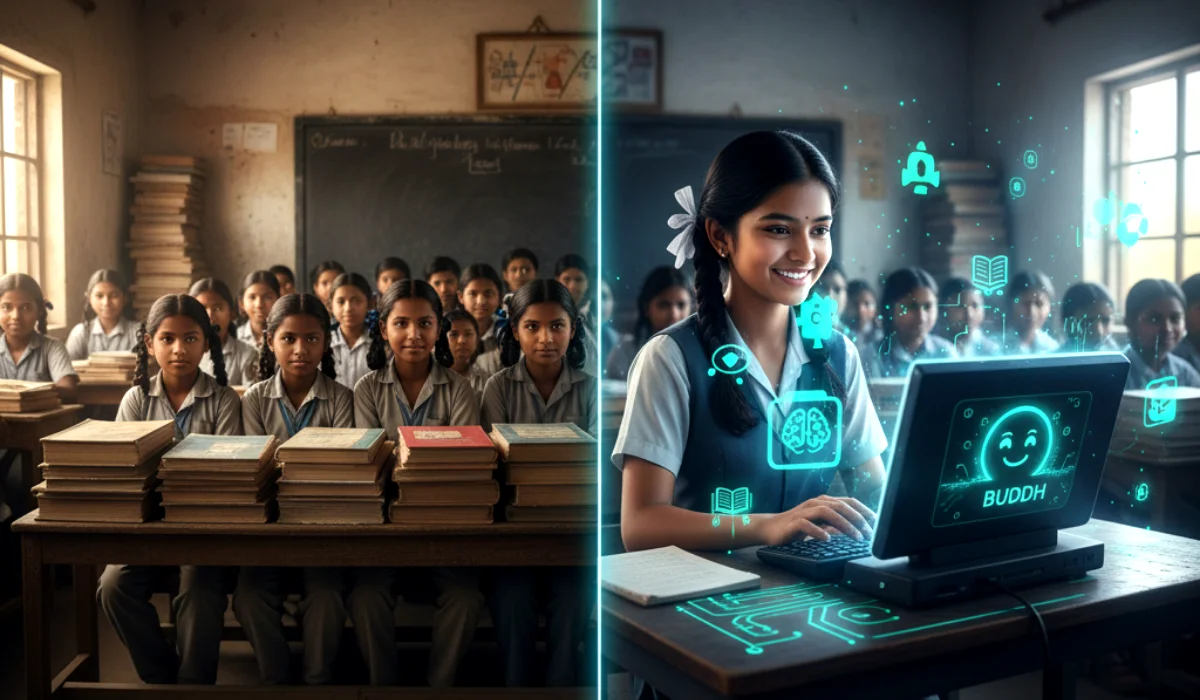
In a move that could reshape the future of education and digital access in India, the state of Karnataka has launched KEO, a compact, AI-ready personal computer with a revolutionary price point.
This isn’t just another low-cost gadget. Developed in collaboration with KEONICS, KEO is a direct assault on the digital divide. With fewer than 10% of Indian households owning a computer, millions of students are being left behind in an increasingly digital world. KEO is designed to change that.
But the most groundbreaking feature isn’t its price; it’s the on-device AI core. KEO comes pre-loaded with BUDDH, a powerful AI learning assistant trained on the official Karnataka state curriculum. Crucially, this AI runs locally on the device, meaning students in even the most remote, low-connectivity areas can have a personalized AI tutor without needing an internet connection.
This is a monumental leap forward in democratizing technology and a potential blueprint for the rest of the nation.
Expert Analysis: “The KEO initiative is strategically brilliant for two key reasons. First, by using an open-source RISC-V processor, Karnataka is sidestepping the global chip monopolies of Intel and ARM. This is a powerful statement about India’s push for technological self-reliance and sovereignty. Second, the focus on an on-device, offline AI tutor is a masterstroke. It directly solves the biggest hurdle for rural education—poor internet connectivity. This isn’t just a PC; it’s a self-contained learning ecosystem.”
What Exactly Is the KEO Computer?
Think of KEO not as a replacement for a high-end laptop, but as a powerful, affordable “first computer” designed for learning and essential digital tasks.
- The Brain: It’s built on a 64-bit quad-core RISC-V processor, an open-source architecture that keeps costs down and promotes innovation.
- The Operating System: It runs on a lightweight, secure Linux-based OS, avoiding expensive licensing fees from Microsoft or Apple.
- The AI Core: The most important feature is the dedicated on-device AI chip, capable of delivering around 4-5 TOPS (trillions of operations per second). This is what allows it to run the BUDDH AI assistant locally.
- Connectivity: It’s packed with all the essential ports you need: 4G, Wi-Fi, Ethernet, USB-A, USB-C, and an HDMI output to connect to any TV or monitor.
BUDDH: The AI Tutor That Doesn’t Need the Internet
The real magic of KEO is the pre-loaded AI agent, BUDDH.
- Offline Learning: Because BUDDH runs on the device’s local AI core, a student in a village with no internet can still ask complex questions about their science homework and get instant, personalized explanations.
- Curriculum-Aligned: The AI has been specifically trained on the Karnataka DSERT (Department of State Educational Research and Training) syllabus, making it a relevant and accurate study partner for students.
- Beyond Textbooks: BUDDH can help with everything from solving math problems to explaining historical events and assisting with programming exercises, acting as a tireless, 24/7 tutor. This is a game-changer for students whose parents may not be able to help them with their homework.
More Than Just a Student PC: A Tool for Digital Governance
While KEO’s primary mission is education, its capabilities extend far beyond the classroom. The state plans to deploy the device across various public sectors.
- Government Offices: For routine documentation, accessing web portals, and managing public records, KEO is an incredibly cost-effective solution for government offices at the panchayat level.
- Public Health Centers: Nurses and healthcare workers in rural clinics can use KEO for patient registration, inventory management, and accessing digital health records.
- Police Stations: It can be used for daily administrative tasks, filing reports, and accessing centralized databases, freeing up police officers’ time.
By providing a standardized, low-cost computing platform, Karnataka is building the essential digital infrastructure needed for efficient, modern governance from the ground up. This is a crucial step in preparing the state’s workforce for a future where AI isn’t taking your job, but forcing you to evolve.
The Rollout Plan: Getting KEO to the People
KEONICS, Karnataka’s state electronics development corporation, will manage the distribution.
- Initial Deployments: The first wave of devices has already been pre-ordered for deployment in schools and panchayat libraries across the state.
- Scaling Up: The government expects demand to scale rapidly, with plans to equip colleges, student hostels, and other government departments in the coming months.
The success of this initiative could create a domino effect, inspiring other states to adopt similar models and fueling a new wave of affordable, AI-ready computing made in India.
Conclusion: A Small Box with a Big Vision
The KEO computer is more than just hardware; it’s a symbol of a new way of thinking about technology and development. It’s a statement that access to powerful AI tools is not a luxury for the rich, but a fundamental right for every student.
By focusing on affordability, open-source technology, and offline AI capabilities, Karnataka has created a powerful and scalable solution to one of India’s most persistent challenges. The KEO project is a bold investment in the state’s human capital and a crucial step towards building a truly inclusive digital future.
Frequently Asked Questions (FAQs)
1. How much will the KEO computer cost?
While the exact price is not yet announced, it is being positioned as a “low-cost” and “affordable” device, with reports suggesting a target price point around Rs. 5,000 to Rs. 7,000.
2. When and where can I buy a KEO computer?
Initially, distribution will be managed by KEONICS for government and educational institutions. A direct-to-consumer plan has not been announced yet but is expected as production scales.
3. Can KEO run Windows or macOS?
No, it is designed to run a lightweight, Linux-based operating system to keep costs low and performance high.
4. What is a RISC-V processor and why is it important?
RISC-V is an open-source instruction set architecture. It means that chip designers can use it without paying expensive licensing fees, which significantly lowers the cost of the final product and promotes homegrown innovation.
5. How powerful is the on-device AI?
It delivers around 4-5 TOPS, which is powerful enough to run specialized AI models like the BUDDH language assistant locally, but it won’t be able to run large, complex models like GPT-4 directly on the device.
6. Is KEO a good replacement for a standard laptop?
For basic tasks like web browsing, document editing, online learning, and using the BUDDH AI, it is very capable. However, it is not designed for heavy-duty tasks like professional video editing or high-end gaming.
7. Can I install my own software on KEO?
Yes, since it runs a Linux-based OS, you will be able to install any software compatible with that operating system.
8. What is the BUDDH AI, and is it only for students?
BUDDH is an AI agent pre-loaded on KEO that is trained on the Karnataka state curriculum to act as an offline study assistant. While its primary focus is education, the underlying AI core can be used for other applications.
9. Does KEO require an internet connection to work?
No. This is its key feature. The device and its core AI assistant, BUDDH, can function completely offline, making it perfect for areas with poor or no internet connectivity.
10. How does KEO compare to the Raspberry Pi?
It is similar in concept to a Raspberry Pi (a small, single-board computer) but is designed as a complete, ready-to-use consumer product with an integrated on-device AI core, which most Raspberry Pi models lack out of the box.
11. Is this the first time a state has launched its own computer?
While there have been initiatives like the Aakash tablet in the past, KEO is one of the first to be built on an open-source RISC-V processor and to include a powerful, offline-first AI agent as its core feature.
12. What are the benefits for digital marketing and local businesses?
Wider computer and internet adoption at the grassroots level creates a larger addressable market for digital services, e-commerce, and local online businesses.
13. How does this impact India’s ‘Make in India’ initiative?
It’s a major boost. By leveraging open-source RISC-V architecture, it encourages local chip design and manufacturing, reducing dependence on foreign technology.
14. What are the potential security concerns?
As with any computing device, security is a concern. However, using a Linux-based OS is generally considered more secure than many alternatives. The state will need a robust plan for issuing security updates, a challenge in low-connectivity areas.
15. Can the BUDDH AI be updated with new information?
Yes, the AI model can be updated, but this would likely require an internet connection or a manual update process managed by KEONICS or educational institutions.
16. Is the KEO computer durable enough for rural use?
The device is described as “compact” and is designed for use in schools and public centers, suggesting it is built to be more robust than a standard consumer laptop.
17. What does “AI-Ready” mean?
It means the device has a dedicated processor (a Neural Processing Unit or NPU) specifically designed to run artificial intelligence tasks efficiently and without needing to connect to the cloud.
18. How will this help reduce school dropout rates?
By providing access to digital learning tools and a personalized AI tutor, it helps students who are struggling or who lack educational support at home, making it easier for them to keep up with their studies.
19. Can I connect a regular keyboard, mouse, and monitor?
Yes, it includes standard USB and HDMI ports, so you can connect all your existing peripherals to use it like a traditional desktop PC.
20. What is the long-term vision for KEO?
The long-term vision is to create a ubiquitous, affordable computing platform that can power digital literacy, education, and e-governance across the entire state, creating a model for a digitally empowered India.