


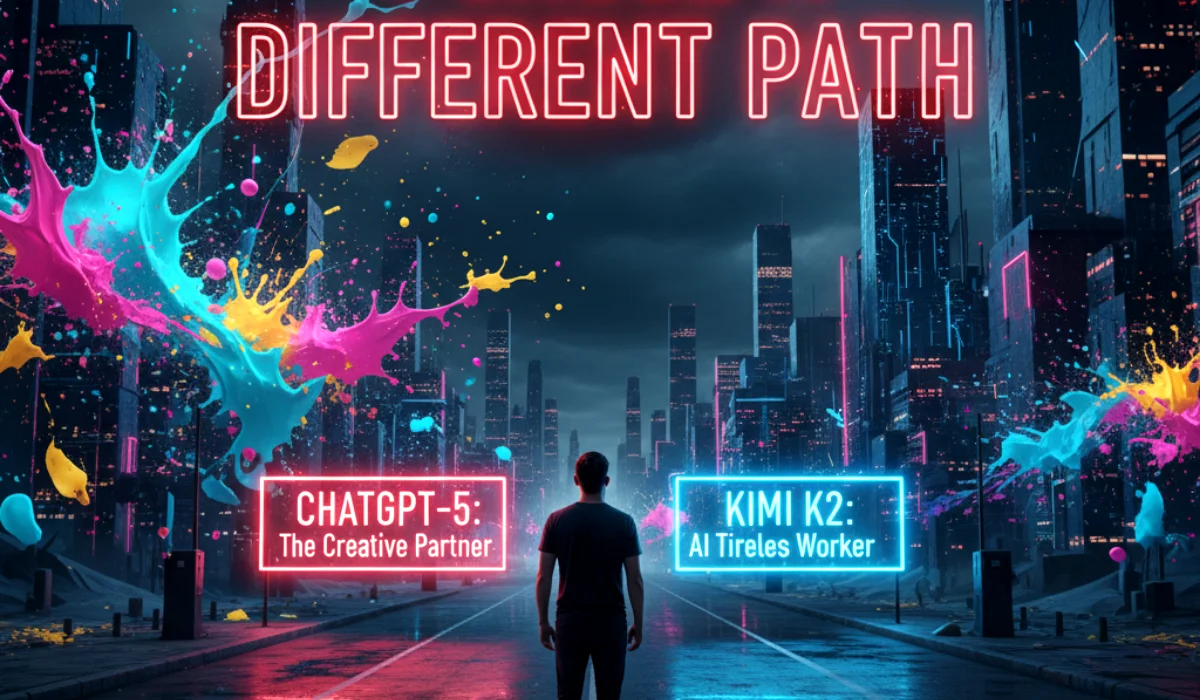
I’ll admit it. When I first heard the hype about Kimi K2 Thinking, the new AI from China’s Moonshot AI, I was skeptical. Another “ChatGPT killer”? I’ve heard that story a dozen times. As someone whose daily workflow is built around OpenAI’s latest and greatest, I assumed this would be another overhyped model that was, at best, a marginal improvement in a niche area.
I was wrong. Completely and utterly wrong.
After spending a week running both Kimi K2 and ChatGPT-5 through the wringer, I can tell you that the AI landscape has fundamentally shifted. This isn’t just an upgrade; it’s a different category of intelligence.
While ChatGPT-5 remains a brilliant, creative conversationalist, Kimi K2 is something else entirely: a tireless, logical, and shockingly effective worker. The winner of my test wasn’t the one I expected, and the reasons why have completely changed how I think about the future of AI.
My Personal Takeaway: Using ChatGPT-5 feels like brainstorming with a brilliant, slightly erratic creative director. Using Kimi K2 feels like handing a complex project to a senior engineer who doesn’t speak much, but who comes back an hour later with perfectly structured, fully-tested code. One is a partner in thought; the other is a force of production.
The Showdown: Where I Tested Both Models
I didn’t want to just rely on abstract benchmarks. I wanted to see how they performed on real-world tasks that I do every day. Here’s how the battle played out.
Round 1: Complex Coding & Debugging
My first test was ambitious. I gave both models a real-world task: “Refactor a 500-line legacy Python script. It has multiple cross-file dependencies, outdated libraries, and no unit tests. Fix it, document it, and write the tests.”
- ChatGPT-5’s Approach: It was impressive, to say the least. It understood the full repository context almost immediately. It correctly identified the outdated libraries and refactored the code in a single, elegant pass. It felt like working with a senior developer who had seen this exact problem a hundred times before. It needed one minor correction on a complex async pattern, but its overall approach was top-tier.
- Kimi K2’s Approach: This is where my jaw dropped. Kimi didn’t just refactor the code. It paused, and then it asked a question: “The goal is to refactor. Before I begin, I will create a test plan to ensure no existing functionality breaks. Do you approve?” It then laid out a step-by-step plan, wrote the tests first, and then refactored the code against those tests, step by step. It took three “turns” to complete the task, but the final output was more robust and came with a complete testing suite. It was slower, but the process was methodical and transparent.
Winner: Kimi K2. While ChatGPT-5 was faster and more elegant in a single shot, Kimi’s “thinking” process of planning and self-verification felt like a more reliable engineering discipline. It wasn’t just coding; it was performing software development.
Round 2: Creative Content & Marketing Copy
Next, I needed to draft a 1,200-word blog post for a new software feature, targeting a non-technical audience. The goal was storytelling and emotional resonance.
- Kimi K2’s Approach: I gave it a fact sheet and my desired tone. The result was… accurate. It was incredibly fast, generating a well-structured draft in under a minute. All the facts were correct, and the technical explanations were clear. But it was dry. The tone was direct and almost mechanical. It felt like a perfect technical document, not an engaging blog post. It required two heavy revision passes from me to inject a human voice.
- ChatGPT-5’s Approach: This is where the OpenAI magic still reigns supreme. It took the same fact sheet and wove a narrative. It used analogies, posed rhetorical questions, and created a smooth, flowing story that was a pleasure to read. It did invent one minor statistic that I had to fact-check and remove, but the overall draft was 90% of the way there. It felt like it was written by a skilled marketing writer.
Winner: ChatGPT-5. For any task that requires nuance, storytelling, or a specific brand voice, ChatGPT’s creative engine is still in a class of its own.
Round 3: Data Analysis & Insight Generation
The final test. I uploaded a CSV with 10,000 rows of fictional sales data and gave both a simple prompt: “Analyze this data and tell me what you find.”
- ChatGPT-5’s Approach: It provided a solid, high-level summary. It correctly identified the top-selling products, the most active sales region, and the general trend over time. It was a good executive summary.
- Kimi K2’s Approach: Kimi’s response was a revelation. It didn’t just give me a summary. It began a multi-step workflow. It first cleaned the data, then performed a sales trend analysis, then a product-level analysis, then a customer segmentation analysis, and finally, it generated three distinct charts and a concluding report with actionable recommendations. It felt less like I was using a tool and more like I had delegated the entire analysis project to a junior data scientist.
Winner: Kimi K2. It didn’t just answer the question; it completed the project. Its ability to chain together multiple analytical steps autonomously is something I have never seen from another AI.
The Verdict: The Winner That Surprised Me
So, which AI is better? The answer completely depends on the task.
- If I want a creative partner to help me write marketing copy, brainstorm ideas, or craft a story, ChatGPT-5 is still my go-to. Its creative and conversational abilities are unmatched.
- But if I have a complex, structured project—be it coding, data analysis, or in-depth research—Kimi K2 is the new champion. Its ability to think, plan, and execute long sequences of tasks without supervision is a superpower that fundamentally changes the nature of work.
The winner that surprised me was Kimi K2, not because it’s “better” at everything, but because it represents a completely new category of AI. It’s the first AI I’ve used that I would trust with a project, not just a prompt. While ChatGPT-5 is an incredible evolution of the chatbot, Kimi K2 feels like the first true step towards an autonomous AI workforce. The hype is real, and the future just got a lot more interesting.
Frequently Asked Questions (FAQs)
1. Is Kimi K2 really better than ChatGPT-5?
It’s better at specific tasks that require long, logical sequences, like coding and data analysis. ChatGPT-5 is still superior for creative writing and nuanced conversation.
2. How is Kimi K2 so much cheaper?
It uses an efficient Mixture-of-Experts (MoE) architecture and native quantization, which reduces the computational power needed for each query. Its open-source nature also avoids the massive overhead of a company like OpenAI.
3. What is “agentic reasoning”?
It’s the ability of an AI to act like an “agent” by planning a series of steps, using tools (like a code interpreter or web browser), and adapting its plan based on the results to achieve a high-level goal.
4. Can I use Kimi K2 for free?
You can use the open-source model for free if you have the technical knowledge and hardware to run it locally. Otherwise, you can access it via paid API services.
5. What is “long-horizon agency”?
This is Kimi K2’s key feature. It’s the ability to maintain context and pursue a goal over hundreds of consecutive steps, unlike other models that tend to get lost or forget the original prompt after a few actions.
6. Does Kimi K2 have a user interface like ChatGPT?
Yes, there are several web interfaces available for Kimi, though the official “product” is the open-source model itself.
7. Why is Kimi K2’s performance on math problems so good?
Its training was heavily weighted towards logical reasoning and its “thinking” process, where it methodically works through problems step-by-step, is perfectly suited for mathematical challenges.
8. What are the downsides of Kimi K2?
Its creative writing can be dry and mechanical, it can sometimes “overthink” simple problems, and as an open-source model, there are greater risks of misuse if not properly governed.
9. Will my conversations with Kimi K2 be used for training?
This depends on the platform or provider you use to access it. If you run the model locally, your data remains private. If you use a third-party service, you must check their privacy policy.
10. What does “Mixture-of-Experts” (MoE) mean?
It’s an AI design where the model is made of many smaller “expert” networks. When you ask a question, the AI only activates the few experts best suited to the task, making it much more efficient than a single, monolithic model.
11. Is Kimi K2 from China a security concern?
For sensitive corporate or government data, the origin and open-source nature of the model would require a thorough security review. For individual, non-sensitive use, it is generally considered safe.
12. Can Kimi K2 understand images and video?
No. Kimi K2 is primarily a text-based model. Multimodal capabilities (understanding images, audio, and video) are a key area where ChatGPT-5 currently has a significant advantage.
13. What is “quantization” and why does it make Kimi K2 faster?
Quantization is a process of reducing the precision of the numbers used in the AI model’s calculations. Kimi K2’s native INT4 quantization means it uses simpler numbers, allowing for much faster processing with a minimal loss of accuracy.
14. Why do some people say Kimi K2 is “less safe”?
Because it is open-source. Anyone can download it and remove any safety guardrails that were built in, potentially using it for malicious purposes. Closed models like ChatGPT-5 are controlled by a single company that enforces safety policies.
15. Does Kimi K2 hallucinate less than ChatGPT-5?
For factual, research-based tasks where it is instructed to stick to provided sources, its hallucination rate is reported to be very low. However, like all models, it can still invent facts on topics outside its training data.
16. Why does Kimi K2 sometimes feel “slower”?
Because of its “thinking” process. For complex tasks, it spends extra time planning and verifying its steps, which adds to the total response time (latency) but often improves the quality and reliability of the final output.
17. What is “Humanity’s Last Exam” (HLE)?
It’s a very difficult benchmark that tests an AI’s ability to perform multi-step, agentic reasoning across thousands of questions, requiring it to use tools and plan ahead. Kimi K2’s high score on this test is a major reason for the excitement around it.
18. Will OpenAI release a competitor to Kimi K2?
It’s almost certain. The success of Kimi’s agentic approach will likely push OpenAI and other labs to develop and release models with similar “thinking” capabilities.
19. As a writer, should I switch from ChatGPT-5 to Kimi K2?
Probably not. For creative writing, marketing copy, and storytelling, ChatGPT-5’s more nuanced and creative language engine is still the superior tool.
20. As a programmer, should I switch from ChatGPT-5 to Kimi K2?
You should absolutely test it. For generating algorithms, solving competitive programming challenges, and performing methodical, multi-step coding projects, Kimi K2 may be a more powerful and reliable tool.


