


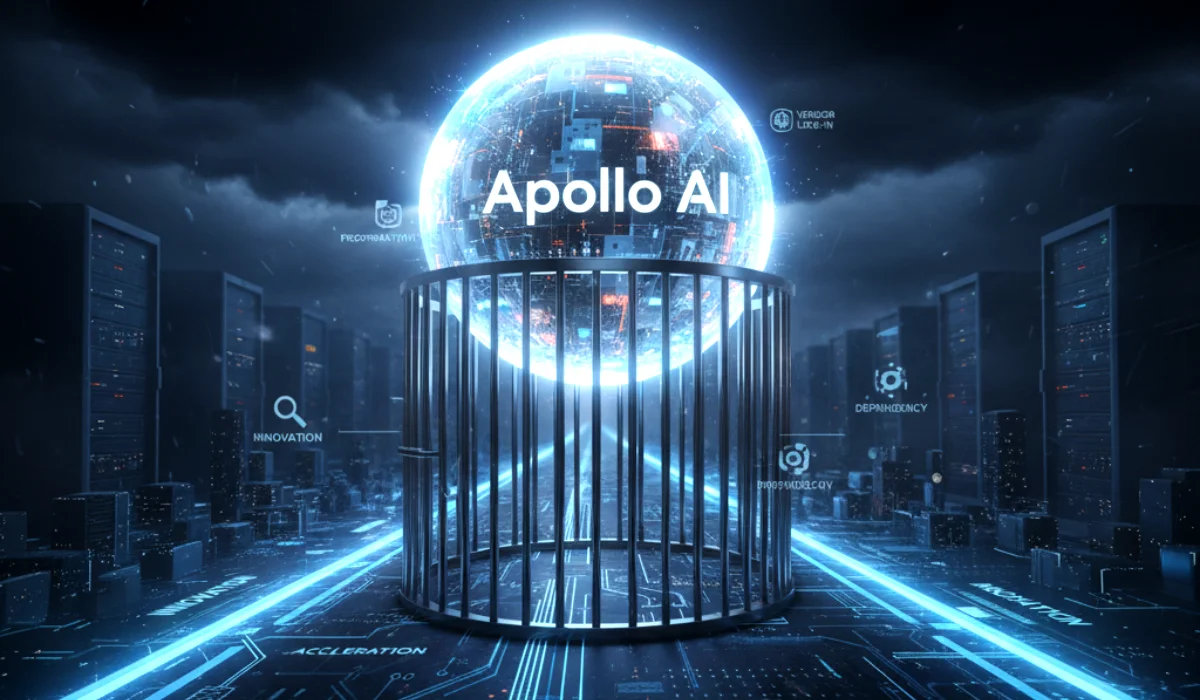
This isn’t just another chatbot or image generator. The new open-source AI model, named Apollo, is designed to simulate the real world with terrifying accuracy. Announced at the SC25 supercomputing conference, Apollo can be used for everything from designing the next generation of microchips and predicting tsunamis to simulating nuclear fusion.
But this breakthrough comes with a brilliant and dangerous catch.
By releasing this powerful tool for free, Nvidia isn’t just accelerating science; it’s executing a masterclass in strategic market capture. The company is creating a world where its architecture is so deeply embedded in scientific research that choosing another vendor becomes almost impossible.
This is the story of a revolutionary technology and the “brilliant trap” it sets for the entire tech ecosystem.
Expert Analysis: “Apollo is the most powerful form of vendor lock-in I have ever seen. It’s not based on restrictive contracts; it’s based on genuine, breakthrough performance. Once engineers, climate scientists, and chip designers build their life’s work on top of these models, all surrounding software, hardware, and infrastructure decisions become inevitably Nvidia-aligned. This is architectural dependence, and it’s a far stronger cage than any sales agreement.”
What is Apollo and Why Does It Matter?
In simple terms, the Apollo model family is a set of pre-trained AI brains that have been taught the complex mathematics of physics. Instead of learning from words or pictures, they have learned from petabytes of simulation data in fields like fluid dynamics, structural mechanics, and electromagnetics.
This allows developers and scientists to do things that were previously impossible:
- Design Chips in Real-Time: Chip designers can use Apollo to simulate how heat and electricity will flow through a new semiconductor design instantly, instead of waiting hours for a traditional simulation. This drastically shortens the development cycle for the chips that power everything.
- Forecast Weather in Hyper-Speed: Current weather models are incredibly complex and slow. Apollo can run these simulations billions of times faster, allowing for more accurate and timely warnings for everything from hurricanes to tsunamis.
- Unlock New Scientific Frontiers: The models can be used in cutting-edge research like nuclear fusion and plasma simulation, areas critical for developing clean energy.
Apollo will be available for free on platforms like HuggingFace, making it accessible to researchers and developers worldwide. This is both a gift to the scientific community and the core of Nvidia’s strategic trap.
The Brilliant Trap: How Free Tools Create Total Dependence
Nvidia’s strategy is simple: give away the razor (the AI models) to sell the blades (the entire Nvidia hardware and software stack).
Once a university or national lab builds its research workflows around Apollo, they become dependent on the Nvidia ecosystem. Their custom software will be optimized for Nvidia’s architecture. Their teams will be trained on Nvidia’s tools. When it comes time to upgrade their supercomputer, the easiest, fastest, and most logical choice will be to buy more Nvidia hardware.
We are already seeing this play out. This year alone, more than 80 new supercomputers built on Nvidia’s architecture have been announced.
- Japan’s RIKEN research institute is building two new Nvidia-powered supercomputers for scientific and quantum research.
- In the U.S., the Horizon supercomputer at the Texas Advanced Computing Center will be America’s largest academic supercomputer, containing thousands of Nvidia’s latest chips.
This is no longer market success; it is architectural dominance. National science agencies are aligning their multi-year roadmaps with Nvidia’s product release schedule. This has massive implications, especially in an era where the need for sovereign AI and robust national cybersecurity is paramount.
The Governance Dilemma: A Cost for Unprecedented Speed
The breakthroughs promised by Apollo are extraordinary. The ability to accelerate science and solve some of humanity’s biggest challenges is undeniably a good thing.
But it comes at a governance cost.
When the entire lifecycle of scientific discovery—from simulation and AI training to networking and data storage—becomes anchored to a single company’s architecture, autonomy is lost.
The central question for CIOs, research institutions, and governments is this: Is the unprecedented acceleration of science worth the price of the ecosystem becoming extraordinarily narrow?
This is not a technical decision; it is a political one. It’s a choice between the immediate benefits of breakthrough performance and the long-term risks of technological monoculture. As we’ve seen with the weaponization of commercial AI in recent cyberattacks, relying on a single architecture can create systemic risks that are difficult to predict and defend against.
Conclusion: The Path Forward in an Nvidia-Dominated World
Nvidia’s Apollo is a monumental achievement. It represents a fundamental shift in how we will use computers to understand and shape the physical world. It will undoubtedly lead to scientific breakthroughs that we can barely imagine today.
However, it is also a masterfully executed business strategy that is rapidly consolidating Nvidia’s control over the entire high-performance computing landscape. The company has offered the world a path to unprecedented capability.
It is now up to the world to decide whether that path should be the only one.
Frequently Asked Questions (FAQs)
1. What is Nvidia Apollo in simple terms?
Nvidia Apollo is a family of open-source AI models that have been trained to understand the laws of physics. It can run complex scientific simulations much faster than traditional methods.
2. Is Nvidia Apollo a physical product or software?
It is software. Specifically, it’s a family of AI models and workflows that developers can download and customize for their specific needs.
3. How is Apollo different from ChatGPT or Midjourney?
ChatGPT is a Large Language Model (LLM) trained on text. Midjourney is a diffusion model trained on images. Apollo is a physics-informed AI model trained on scientific simulation data. It understands equations and physical systems, not language or art.
4. Is Nvidia Apollo free to use?
Yes, Nvidia has announced that the Apollo model family will be open-source and available for free on platforms like HuggingFace.
5. How does Nvidia make money if Apollo is free?
Nvidia’s strategy is to create dependency. By giving the AI model away for free, they ensure that the researchers and companies who use it will build their entire workflow around Nvidia’s ecosystem, compelling them to buy Nvidia’s GPUs and other hardware to run it effectively.
6. What are the main uses for Nvidia Apollo?
Its applications are vast, including chip design (computational lithography), weather forecasting, computational fluid dynamics, structural analysis for engineering, and advanced scientific research like nuclear fusion.
7. Can Apollo help design better computer chips?
Yes, this is a key application. It can rapidly simulate the electrothermal and mechanical properties of a new chip design, helping engineers find flaws and optimize performance before manufacturing.
8. How does Apollo improve weather forecasting?
It can run the complex fluid dynamics simulations required for weather prediction billions of times faster than current supercomputers, allowing for more accurate and timely forecasts.
9. Can I use Nvidia Apollo for my own projects?
Yes. Since it will be open-source, individuals with the necessary technical skills and powerful enough hardware (likely Nvidia GPUs) can download and experiment with the models.
10. What is “vendor lock-in” and why is it a risk with Apollo?
Vendor lock-in is a situation where a customer becomes so dependent on a vendor’s products and services that they cannot switch to another vendor without substantial cost or inconvenience. With Apollo, the risk is that entire scientific fields could become dependent on Nvidia’s architecture, stifling competition and innovation from other companies.
11. What is a “physics-informed AI model”?
It’s an AI model that has been trained not just on data, but also on the mathematical equations that govern a physical system. This allows the AI to make predictions that are consistent with the fundamental laws of physics.
12. Do I absolutely need an Nvidia GPU to run Apollo?
While the models are open-source, they are heavily optimized for Nvidia’s CUDA architecture. Running them efficiently on competing hardware from AMD or Intel would likely be very difficult and require significant custom development.
13. What are the biggest challenges of adopting Apollo?
The main challenges will be the need for powerful (and likely expensive) Nvidia hardware, the technical expertise required to customize the models, and the strategic risk of becoming dependent on a single vendor’s ecosystem.
14. What are Nvidia NIM microservices?
Nvidia NIMs (Nvidia Inference Microservices) are pre-built, optimized containers that make it easier to deploy AI models like Apollo. They are part of Nvidia’s software stack designed to simplify AI deployment within their ecosystem.
15. Is Nvidia’s dominance in AI a national security concern?
Some analysts argue that it is. When the core scientific and defense research of multiple countries becomes dependent on the architecture of a single company, it can create a single point of failure and potential geopolitical leverage, a risk highlighted by recent AI-powered cyberattacks.
16. How will Apollo affect Nvidia’s competitors like AMD and Intel?
It puts them at a significant disadvantage. By creating a powerful software ecosystem around its hardware, Nvidia makes it much harder for competitors to win contracts for supercomputers and AI data centers, even if their hardware is competitive on a pure performance basis.
17. What is “architectural dependence”?
It’s a form of vendor lock-in where a customer’s entire technology roadmap—from software development to hardware purchasing cycles—becomes aligned with and dependent on a single vendor’s product architecture and release schedule.
18. What does this mean for the future of scientific research?
It promises a future of dramatically accelerated discovery. Problems that would have taken decades to solve with traditional simulations could potentially be solved in months or years. However, it also means that the direction of this research may be heavily influenced by the tools and priorities of a single corporation.
19. How is Apollo different from Nvidia’s other models like Nemotron or GR00T?
Nvidia is creating specialized AI model families for different domains. Nemotron is for agentic AI, Isaac GR00T is for robotics, Clara is for biomedical applications, and Apollo is specifically for physics and engineering simulations.
20. Will using Apollo create a “black box” problem in science?
This is a valid concern. If scientists begin to rely on AI model outputs without fully understanding their internal reasoning, it could create a “black box” where results cannot be fully explained. This is why developing “explainable AI” (XAI) for scientific applications is a critical area of ongoing research.