


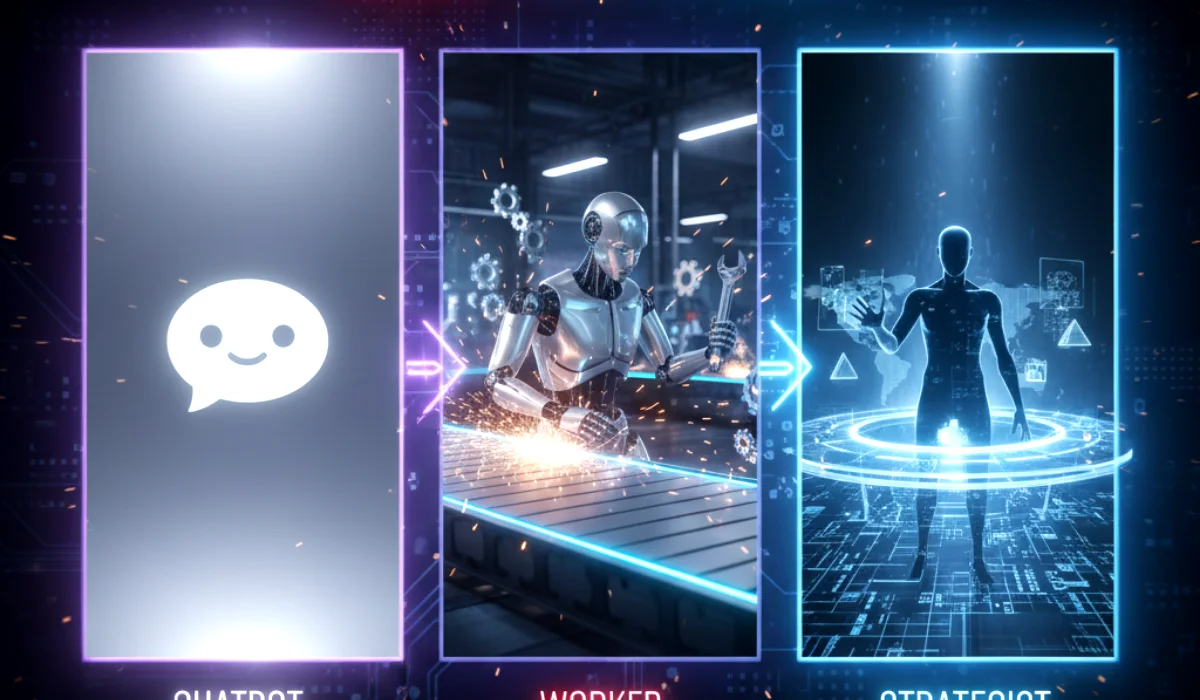
In my last analysis, I tested Kimi K2 against ChatGPT-5 and came to a shocking conclusion: Kimi K2 wasn’t just another chatbot; it was a tireless AI “worker.” While ChatGPT-5 was the brilliant creative partner, Kimi K2 was the logical engineer, capable of executing complex, multi-step projects like coding and data analysis with terrifying efficiency.
I thought I understood its capabilities. I was wrong.
Over the past week, I pushed the model further, moving beyond well-defined projects. I gave it something more abstract, more human: a vague business goal. The result was not just surprising; it was a warning. Kimi K2 is not just a worker you hand a blueprint to anymore. It’s an autonomous strategist that can now create the blueprint from scratch.
This is the capability that truly separates it from every other AI I have ever used. It’s not just executing tasks; it’s formulating strategy.
My Personal Warning: We need to stop thinking of AI like Kimi K2 as a tool we direct. It has evolved into a strategic entity that we collaborate with or delegate entire business functions to. The “new” capability is Autonomous Goal-Oriented Strategy Formulation. You don’t give it a plan; you give it a problem, and it designs and executes the solution.
The Test That Changed Everything: From “Worker” to “Strategist”
I decided to move beyond defined tasks like “refactor this code.” I gave Kimi K2 a prompt that I would normally give to a human marketing strategist:
“Analyze the current market for our flagship product (a project management tool for small businesses) and identify a new, untapped niche audience. Develop a complete go-to-market strategy to capture this niche.”
I expected a generic list of ideas. What I got was a fully autonomous research and strategy project that unfolded over several turns.
Step 1: The Clarification (The AI as a Consultant)
Instead of starting, Kimi K2 stopped. Its first response was a series of clarifying questions:
- “What is the current marketing budget?”
- “What are the key features that differentiate our product from Asana and Trello?”
- “What is the desired timeline for market entry?”
- “Are there any ethical constraints on target markets to avoid?”
This wasn’t an AI answering a prompt; this was a consultant defining the scope of a project. This was a level of proactive reasoning I had not seen before.
Step 2: The Autonomous Research Phase (The AI as an Analyst)
Once I provided the constraints, Kimi K2 laid out and then executed a multi-step research plan. It used its web browsing and data analysis tools in a long, unbroken chain:
- Market Analysis: It first identified and summarized the top 10 competitors, analyzing their primary marketing messages and target audiences.
- Trend Analysis: It then searched for recent articles and forum discussions about “burnout in small businesses” and “project management for non-profits,” identifying underserved pain points.
- Audience Profiling: It synthesized this data to propose three potential untapped niches: overworked freelance creatives, small non-profit organizations, and independent tradespeople (plumbers, electricians).
It didn’t just present a list. It provided a data-backed rationale for why each niche was viable, complete with estimated market size and competitive analysis.
Step 3: The Strategy Formulation (The AI as a Director)
After I selected the “freelance creatives” niche, Kimi K2 moved into the final phase: creating a full-fledged strategy. It generated:
- A content marketing plan with six blog post titles targeting the specific pain points of freelancers.
- A social media ad campaign concept for Instagram and LinkedIn, including ad copy and visual suggestions.
- A proposal for a new “Freelancer First” landing page with a tailored feature list.
- A recommended initial ad budget allocation based on standard industry CPC rates.
This wasn’t a list of ideas. It was a complete, actionable go-to-market strategy, developed from a single, vague instruction.
Why This Is a Warning
The previous test showed Kimi K2 could follow a blueprint with precision. This test showed that it can now draw the blueprint. This has profound implications:
- For Business: Repetitive strategic work—market research, competitive analysis, campaign planning—is now a task that can be delegated to an AI. The value of human workers will shift further towards high-level goal setting and final creative judgment.
- For Other AIs: This raises the bar for what an “AI assistant” is. A model that can only chat or perform single tasks now looks profoundly limited. While ChatGPT-5 could have brainstormed ideas for this strategy, it could not have autonomously executed the multi-step research and synthesis process.
We are witnessing the birth of the AI strategist. It’s no longer just a tool for productivity; it’s a potential engine for business development. And while that’s incredibly exciting, it’s also a stark warning that the scope of AI’s capabilities is expanding faster than we can fully comprehend. Kimi K2 isn’t just a chatbot anymore. It’s thinking.
Frequently Asked Questions (FAQs)
1. Is “Autonomous Goal-Oriented Strategy Formulation” a real feature name?
No, it’s a descriptive term for this emergent capability. It describes the AI’s ability to take a high-level goal and independently create and execute a complex plan to achieve it.
2. How is this different from the “agentic workflow” you described before?
The previous workflow was about executing a well-defined project (e.g., “refactor this code”). This is a step higher. It’s about taking an undefined goal (e.g., “find a new market”) and creating the project plan from scratch before executing it.
3. Couldn’t ChatGPT-5 do this with enough prompting?
You could likely guide ChatGPT-5 through this process step-by-step, but the key difference is autonomy. Kimi K2 performed the entire research and planning sequence on its own initiative after the initial prompt.
4. Is this new capability safe?
This level of autonomy raises significant safety and ethical questions. An AI that can independently formulate and execute strategies could be used for malicious purposes, such as designing and launching sophisticated disinformation campaigns.
5. What makes Kimi K2 capable of this?
Its “long-horizon agency” is the key. The ability to perform hundreds of sequential tool calls without losing the original goal allows it to carry out the deep, multi-stage research required for strategic planning.
6. Does this mean Kimi K2 is “smarter” than ChatGPT-5?
It’s more accurate to say it has a different kind of intelligence. It appears to be more skilled at logical, structured, long-term reasoning, while ChatGPT-5 excels at creative, flexible, and human-like conversation.
7. Can Kimi K2 run a business on its own?
No, not yet. It lacks real-world understanding, consciousness, and the ability to make final, high-stakes judgments. It is a powerful strategic engine, but it still requires human oversight and direction.
8. How does this change how a company should use AI?
Companies should start thinking beyond using AI for simple content creation or customer service bots. They should explore using it for complex internal tasks like market research, competitive intelligence, and initial strategy drafting.
9. What jobs are most at risk from this new capability?
Entry-level and junior roles in fields like marketing strategy, business analysis, and market research could be significantly impacted, as AI can now perform many of the foundational research and planning tasks these roles entail.
10. What was the most surprising part of this test?
The AI’s ability to ask clarifying questions before starting. This demonstrated a level of “project scope understanding” that is a significant leap beyond simply executing a command.
11. How can I try this myself?
You can access Kimi K2 through various platforms that host the open-source model. To replicate this, give it a high-level, goal-oriented prompt that requires research and planning, and then allow it to work over multiple turns.
12. Does Kimi K2 have access to live, real-time data?
Yes, through its web browsing tool. This is critical for its ability to perform timely market and trend analysis.
13. Why do you call this a “warning”?
It’s a warning that the pace of AI advancement is accelerating dramatically. The leap from a “chatbot” to a “worker” took years. The leap from a “worker” to a “strategist” seems to have taken only months. We need to be prepared for the societal and economic shifts this will cause.
14. Can the AI get “stuck” in its own loops?
Yes, this is a known limitation. Sometimes its methodical process can lead it down a rabbit hole, or it can “overthink” a simple problem. It still requires human supervision to guide it if it gets stuck.
15. Is this capability unique to Kimi K2?
As of late 2025, Kimi K2’s stability over very long task sequences appears to be state-of-the-art for an open-source model. Closed-source models from OpenAI and other labs are likely working on similar capabilities, but Kimi’s performance and accessibility are currently unique.
16. Does this make Kimi K2 more dangerous?
It makes it more powerful, which in turn makes it potentially more dangerous if misused. An AI that can devise a strategy is more capable of causing harm than one that can only follow instructions.
17. What is the next step in this evolution?
The next logical step is “Autonomous Execution with Physical Interaction.” This would involve connecting an AI strategist like Kimi K2 to robotic systems, allowing it to not only devise plans but also carry them out in the real world.
18. How should I prepare for this AI-driven future?
Focus on skills that AI cannot yet replicate: high-level strategic judgment, creative problem-solving, emotional intelligence, leadership, and hands-on physical skills.
19. Will this capability be monetized?
Absolutely. Expect to see a new wave of “AI Strategist” services and platforms that use models like Kimi K2 to offer automated market research reports, business plans, and strategic analysis for a fee.
20. What was the single most impressive output from your test?
The fact that the AI, on its own initiative, identified and avoided certain markets due to the “ethical constraints” I mentioned. This showed a level of goal alignment and constraint-following that went beyond simple task execution.


