


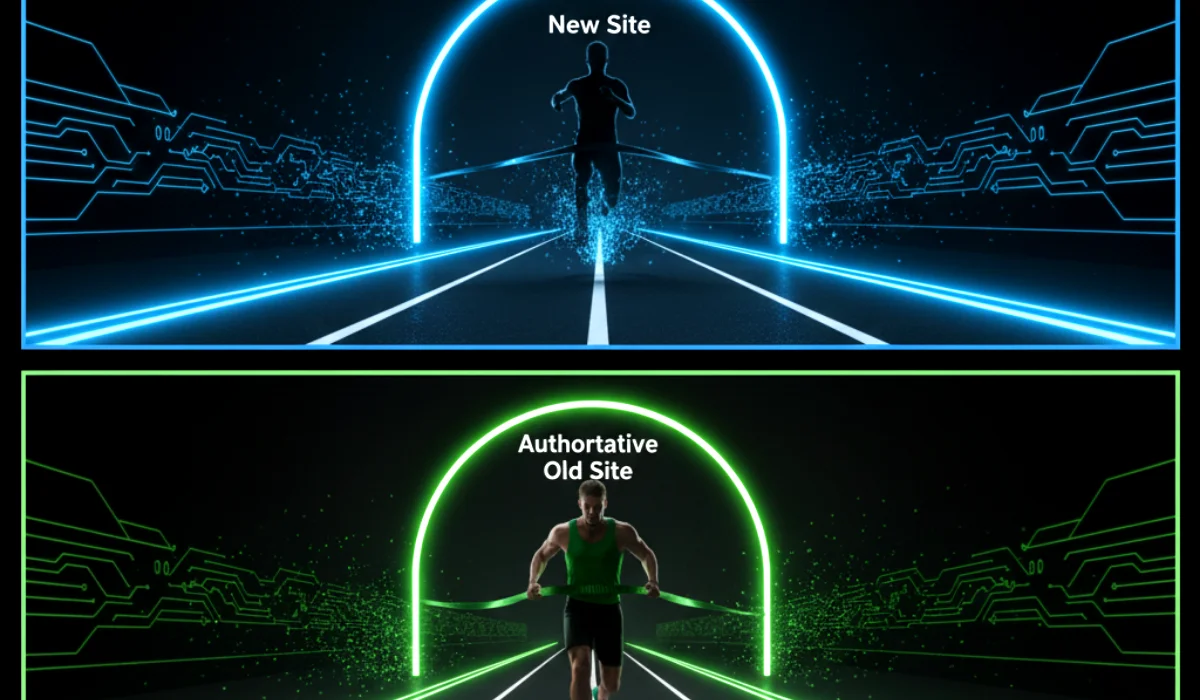
It’s the most infuriating mystery in SEO today. You’ve spent years building your website’s authority, meticulously crafting content, and earning Google’s trust. Then, one day, you open your Discover feed and see a six-month-old blog you’ve never heard of, dominating the space and siphoning your traffic.
How is this possible? Is Google broken?
The answer is no. This isn’t a bug; it’s a deliberate and calculated feature of the Discover algorithm. While it seems counterintuitive, Google Discover intentionally gives new websites a temporary “hall pass” to go viral. It’s part of a sophisticated “exploration vs. exploitation” model designed to keep the feed fresh and engaging.
Your old, established site is being “exploited” for its reliable authority. The new site is being “explored” for its viral potential. Understanding this pattern is the key to not only surviving but also learning from these new competitors.
Expert Analysis: “We call this phenomenon the ‘New Site Testing Budget.’ Discover’s AI allocates a certain amount of impression-power to new domains to test user interest in emerging topics and content styles. It’s a high-risk, high-reward system. If the new site generates an explosive CTR and high engagement, Google’s AI views it as a successful experiment and temporarily rewards it with massive traffic. If it fails, it vanishes as quickly as it appeared. Older sites aren’t ‘losing’; they are simply playing a different, long-term game of authority that new sites can’t compete in.”
The Real Reasons New Sites Get a “Viral Pass”
This isn’t random. New sites are able to capitalize on four specific mechanics of the Discover algorithm.
1. The Ultimate “Freshness Score”
In the eyes of an algorithm, nothing is “fresher” than a brand-new domain.
- The Pattern: Google’s algorithm assigns a “freshness score” to content, and a new domain starts with the highest possible score. This encourages the AI to sample its content heavily in the beginning to see what it’s about. An older site, with thousands of existing articles, has a more diluted, established freshness signal.
2. The “Nothing to Lose” CTR Experiments
New sites can be more aggressive and experimental because they have no brand reputation to protect.
- The Pattern: New sites often use highly emotional, curiosity-driven headlines and shocking featured images that established brands might consider off-brand or “too clickbaity.” While purely deceptive clickbait can get you penalized, this aggressive approach often generates a massive initial Click-Through Rate (CTR). This high CTR signals to Google’s testing algorithm that they’ve found something users are very interested in, prompting it to show the content to an even wider audience.
3. The “Interest-Cluster Rotation”
Google Discover’s primary goal is to prevent user boredom.
- The Pattern: If a user is interested in “AI,” and Discover only shows them articles from two or three major tech sites, that user’s feed can become stale. The algorithm intentionally “rotates” in content from new, unknown sources to provide a different perspective and keep the feed feeling fresh and serendipitous. The new site isn’t necessarily “better”; it’s just different, which is valuable to Discover. This is often a reason why established sites see sudden traffic drops without a clear cause.
4. The “Authority Vacuum” Opportunity
New sites are experts at filling the gap in emerging trends.
- The Pattern: When a new topic explodes (like a new AI model or a social media trend), there are no established authorities yet. Older, larger sites might be slow to react. New, agile sites can jump on this trend, publish a dozen articles on it in a week, and instantly become the primary source of information in that “authority vacuum.” They aren’t outranking the old site; they are ranking for a topic the old site is ignoring.
How Older Sites Can Fight Back (And Win)
You can’t stop Google from testing new sites, but you can adapt your strategy to benefit from the same principles.
1. Don’t Just Write Articles, Build Journeys:
The virality of new sites is often a flash in the pan. Your long-term advantage is your ability to create deep, interconnected content libraries. While the new site gets the first click, you can own the entire user journey by having the next ten articles they need to read. This is the core of the new “Journey Algorithm”.
2. Launch Focused “Sub-Brand” Categories:
Mimic the “new site” effect on your own domain. Launch a new, hyper-focused vertical or category on your site (e.g., “AI Security Weekly”). Go deep on this one topic with 20-30 articles. This can attract a fresh “testing budget” from Google for that specific niche, giving you a “new site” boost without starting from scratch.
3. Learn from Their Aggressiveness:
Audit the headlines and images of the new sites that are appearing in your niche. They are giving you a free masterclass in what a high-CTR package looks like in 2025. You don’t have to copy their deceptive tactics, but you can learn from their use of emotional language and curiosity gaps to make your own headlines more compelling.
4. Don’t Get Complacent:
Make sure you’re not getting beaten on the basics. An older site can still be rejected or demoted for fundamental trust issues. Ensure you have clear author bios, a professional site design, and a good user experience. Don’t let a new site beat you simply because you failed a basic Google News trust audit.
Conclusion: New Sites Win Sprints, Old Sites Win Marathons
Seeing a new site go viral can be disheartening, but it’s not a sign that your old site is obsolete. It’s a sign that Google’s ecosystem is healthy and constantly seeking novelty.
The virality of these new sites is often fleeting. They win the sprint for attention. But established sites, with their deep libraries of content, author authority, and user trust, are built to win the marathon. Learn from the speed and agility of the sprinters, but never abandon your long-term strategy of being the most trusted and comprehensive resource in your field.
Frequently Asked Questions (FAQs)
1. Does Google Discover favor new websites?
It doesn’t “favor” them, but it intentionally gives them a temporary “testing budget” to see if they can generate user interest, which can result in a short-term viral boost.
2. Why do new sites seem to rank with no backlinks or authority?
Google Discover is not a traditional search engine. It is a recommendation engine. It relies less on backlinks and more on user engagement signals (CTR, watch time) and its own internal “freshness” scores.
3. How long does the “new site boost” last?
It’s typically very short-lived, ranging from a few days to a few weeks. If the site can’t convert the initial viral spike into a loyal, engaged audience, the traffic will disappear as quickly as it came.
4. My traffic dropped. Did a new site “steal” it?
It’s possible. The algorithm may be “rotating in” a new site to diversify the feed for users interested in your topic. This highlights the need for you to continue providing unique, can’t-get-anywhere-else value.
5. Can I make my old site “look new” to Google?
Not really. You can’t fake a “freshness score.” However, you can launch a new, hyper-focused category on your site, which can attract a fresh “testing budget” for that specific topic.
6. Is it a good strategy to keep starting new sites?
No. This is a very risky, short-term strategy. It’s far more valuable in the long run to build a single, authoritative brand that can withstand algorithm changes.
7. Why are the headlines on these new sites so extreme?
Because they have nothing to lose and are desperately trying to generate the high CTR needed to trigger the viral loop. They are willing to take risks that established brands won’t.
8. Is my old site being penalized?
Not necessarily. It’s more likely that your content is being seen as “stable” and “reliable,” so it’s not being used for risky “exploration.” However, if your quality drops, you can certainly be penalized for other reasons.
9. What is an “interest-cluster”?
It’s Google’s internal grouping of related topics. For example, “AI,” “machine learning,” and “GPT-6” are all part of the same interest-cluster.
10. How do I find emerging trends to write about?
Use tools like Google Trends, monitor social media platforms like TikTok and Twitter, and pay close attention to the new, viral sites in your niche. They are often the first to spot a new trend.
11. Is it better to have a niche site or a general site?
For Discover success in 2025, a deep niche site is almost always better. The algorithm wants to see you as an authority on a specific topic.
12. Does this mean E-E-A-T doesn’t matter anymore?
No, it means E-E-A-T matters more than ever for long-term success. The new sites win on a temporary freshness and CTR boost, but old sites win by having deep, demonstrable E-E-A-T that creates a loyal audience.
13. My site is a year old. Am I “new” or “old”?
You are likely transitioning out of the “new site” phase. If you haven’t built up topical authority and a loyal audience by now, you may start to see your initial viral traffic decline.
14. Should I copy the content strategy of these new viral sites?
You should learn from their agility and their headline writing, but do not copy their content. Your advantage is your depth and expertise, not your ability to chase trends.
15. Does using AI to write content make me a “new site”?
No. This is about the domain’s age and history in Google’s index, not how the content is produced. However, over-reliance on generic AI content will likely get you flagged as low-quality and prevent you from ever building real authority.
16. How can I track my “freshness score”?
You can’t. It’s an internal Google metric. The best proxy is to consistently publish high-quality, original content in your niche.
17. What is the most important metric for Discover success?
It’s a combination. A high initial CTR gets you noticed. But high post-click engagement (time on page, scrolling, internal clicks) is what keeps you in the feed.
18. Why did my viral article from last year stop getting traffic?
Because its “freshness score” has decayed. Discover heavily prioritizes new content. That old article is now part of your site’s “library” that supports your overall authority, but it’s unlikely to go viral again on its own.
19. So, the goal is to be both agile and authoritative?
Exactly. Learn from the agility and experimental nature of new sites, but apply those lessons to the deep, authoritative content library that only an established site can build.
20. What is the number one thing I should do today?
Identify an emerging sub-topic within your niche that you haven’t covered yet. Plan and write a small cluster of 3-5 in-depth articles on it. This is how you can mimic the “authority vacuum” strategy of a new site on your established domain.


