


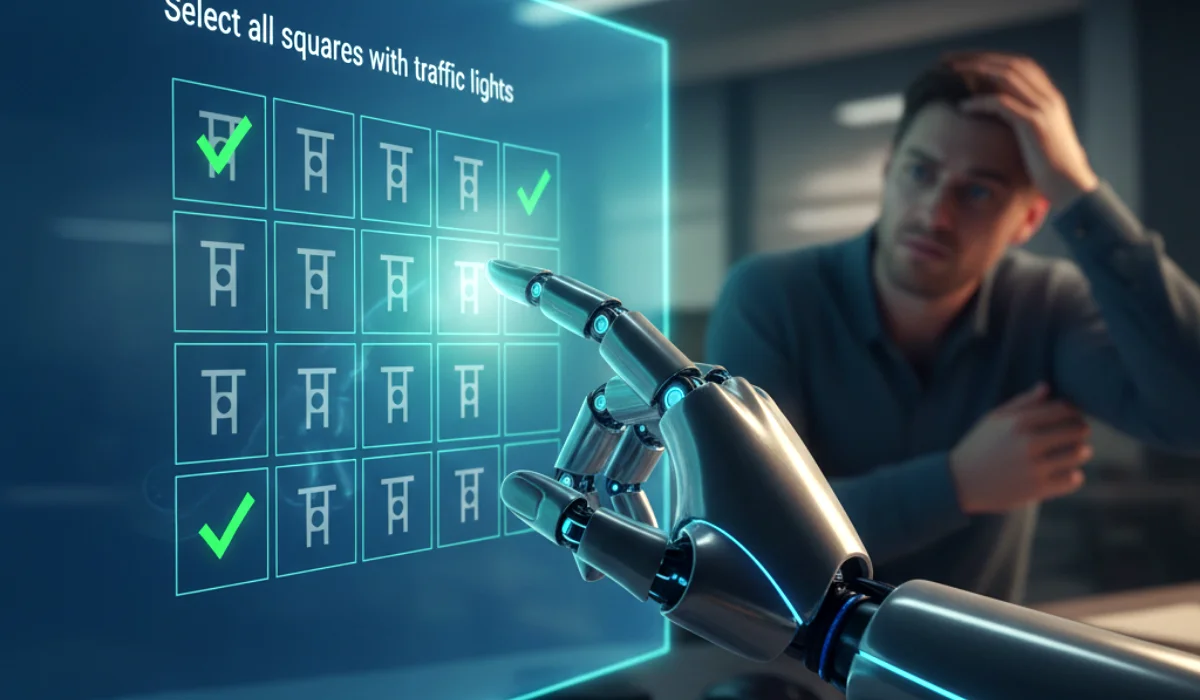
For over two decades, it has been the web’s first line of defense against bots, the universally recognized, slightly annoying ritual we perform to prove our humanity: the CAPTCHA.
New research and demonstrations from independent security labs have confirmed what many have feared: modern AI has completely and irrevocably “solved” CAPTCHA. Advanced AI models can now bypass every form of this test—from distorted text and fuzzy images to the “click all the traffic lights” puzzles and even Google’s “invisible” reCAPTCHA v3—with over 99% accuracy and at superhuman speeds.
The era of static “human verification” is over. We are now in a new, more dangerous phase of the internet where spam, credential stuffing, and large-scale bot attacks are about to become exponentially worse.
This has forced a scramble inside companies like Google, which are now reportedly fast-tracking a new system, unofficially dubbed “Human Verification 3.0,” that will fundamentally change how we prove we’re human online.
Expert Analysis: “We’ve been watching this train wreck in slow motion for years. The core assumption of CAPTCHA—that humans are better than computers at pattern recognition—has been obsolete for at least 18 months. What’s new is that AI can now perfectly mimic human behavior, defeating the invisible reCAPTCHA systems that track mouse movements and clicks. This isn’t an incremental failure; it’s a total system collapse. Static challenges are dead. The future is a continuous, AI-driven arms race where your passive behavior becomes your new password.”
How AI Became the Ultimate CAPTCHA-Slayer
AI didn’t just get a little better at solving puzzles; it developed a suite of superpowers that make it the perfect CAPTCHA-breaking machine.
1. Superhuman Vision
Modern computer vision models, similar to those that power self-driving cars, can now identify objects with near-perfect accuracy, no matter how distorted or obscured they are.
- The Attack: AI models are shown millions of examples of CAPTCHA images (street signs, buses, bicycles) and quickly learn to identify them with more precision than the average human. Wavy text, distorted numbers, and blurry images are no longer a challenge.
2. Flawless Hearing
The audio CAPTCHA, designed as an accessibility alternative, has also been completely broken.
- The Attack: AI transcription models, like OpenAI’s Whisper, can parse heavily distorted and noisy audio clips, accurately transcribing the spoken words or numbers with ease.
3. Perfect Mimicry: The reCAPTCHA v3 Killer
This is the most significant breakthrough. Google’s reCAPTCHA v3 was supposed to be the ultimate defense because it didn’t present a puzzle. Instead, it “invisibly” analyzed your behavior on a page—how you move your mouse, your scrolling speed, the rhythm of your clicks—to generate a “humanity score.”
- The Attack: Modern agentic AI systems have been trained on vast datasets of human browsing behavior. They can now generate mouse movements that are not just random, but have the subtle curves, slight pauses, and micro-corrections of a real human hand. They can scroll down a page, wait a few seconds, and click a button in a way that is statistically indistinguishable from a person.
The Consequences: A Tsunami of Spam and Attacks
With CAPTCHA now effectively useless, the floodgates are open for a new wave of automated threats.
- Mass Account Creation: Bot armies can now create millions of fake accounts on social media, email services, and e-commerce sites, which will be used for spam, scams, and spreading misinformation.
- Credential Stuffing Overload: Hackers can use bots to test stolen username/password combinations against thousands of websites per minute without being stopped by CAPTCHA challenges, leading to a massive increase in account takeovers.
- Inventory Scalping: E-commerce sites will be overwhelmed by “scalper bots” that can instantly buy up all the stock of limited-edition products (like sneakers or concert tickets), leaving none for real customers.
The Future: What is “Human Verification 3.0”?
With the old system broken, Google and other security leaders are developing a new paradigm for proving humanity online. The focus is shifting from a single challenge to continuous, behavioral biometrics.
1. Continuous Keystroke Dynamics
- How it Works: The system analyzes the unique rhythm and cadence of your typing over an entire session. It learns your personal typing style—how long you hold down keys, the time between key presses, and your common typos. It’s like a fingerprint for your typing.
2. Mouse Movement and Device Gyroscope Analysis
- How it Works: Beyond just mouse path, the new system will analyze the micro-tremors of your hand. If you’re on a phone, it will use the accelerometer and gyroscope to analyze the subtle way you hold and move your device, which is unique to you.
3. AI-Powered Conversational Turing Tests
- How it Works: Instead of a simple puzzle, the system might present a more abstract, AI-generated challenge that requires genuine human reasoning or cultural context. For example:
- A pop-up showing a bizarre image and asking, “What is happening here?”
- A simple, open-ended question like, “Describe the color blue to someone who can’t see.”
4. Deeper Integration with Hardware Trust (Passkeys)
- How it Works: The future is less about proving you’re human and more about proving you are using a trusted device. Systems like Passkeys, which link your identity to your physical phone or laptop via biometrics (fingerprint or face scan), will become a primary method of “human verification,” completely bypassing the need for puzzles.
Conclusion: The End of an Era, The Start of a Race
CAPTCHA is dead. It was a good soldier in the war against bots, but the enemy has evolved, and the old defenses are no longer viable.
We are entering a new and more complex era of online security. The clear line between human and bot is blurring, and the methods used to tell them apart must become far more sophisticated. The move towards continuous behavioral analysis and hardware-based trust represents a fundamental change in our relationship with the web. It promises a future with fewer annoying puzzles, but one where our very behavior becomes the key to our digital identity. The AI arms race has come to the “I’m Not a Robot” button, and the internet will never be the same.
Frequently Asked Questions (FAQs)
1. Is CAPTCHA officially dead?
While websites still use it, its effectiveness against modern AI bots is now close to zero. For all practical purposes, as a security measure against sophisticated threats, it is obsolete.
2. Can AI really solve all types of CAPTCHAs?
Yes. Current AI models have demonstrated over 99% success rates against text, image (including “I’m a human” checkboxes), and audio CAPTCHAs, as well as the behavioral analysis of reCAPTCHA v3.
3. What does this mean for my online accounts?
It means they are at a higher risk of brute-force and credential-stuffing attacks. It is more important than ever to use strong, unique passwords for every site and enable two-factor authentication (2FA).
4. What is “Human Verification 3.0”?
It is the unofficial name for the next generation of bot detection systems that are being developed. These systems will rely on continuous behavioral biometrics (like your typing rhythm) and hardware trust signals (like Passkeys) instead of static puzzles.
5. Is reCAPTCHA v3 completely useless now?
Against sophisticated AI agents, yes. These agents can now mimic human-like mouse movements and interaction patterns, making them indistinguishable from real users to the reCAPTCHA v3 system.
6. Will I still see “I’m not a robot” boxes?
For a while, yes. Many smaller websites will be slow to update their security, so you will still encounter old CAPTCHAs, but they offer very little real protection.
7. How does “keystroke dynamics” work?
It’s a form of biometric identification that analyzes the unique rhythm and timing of your typing. The system measures things like how long you hold down each key and the time between your keystrokes to create a unique “typing fingerprint.”
8. Is analyzing my behavior a violation of privacy?
This is a major ethical concern. These new systems will be analyzing more of your passive behavior, and there will be a strong debate around how this data is collected, stored, and used.
9. What are Passkeys and how do they help?
Passkeys are a new technology that replaces passwords. They use the biometrics on your device (like your fingerprint or face) to prove your identity. This is a much stronger form of security because a bot cannot fake your fingerprint.
10. How can I protect my website from bots now?
You need to use a multi-layered security approach. Do not rely on CAPTCHA alone. Implement strong two-factor authentication (2FA), use a Web Application Firewall (WAF), and monitor for suspicious login activity.
11. What AI models can solve CAPTCHAs?
While no single “CAPTCHA-solver” AI is publicly marketed, the capabilities are a combination of advanced open-source computer vision models (like YOLO), transcription models (like Whisper), and reinforcement learning techniques for mimicking behavior.
12. Is Google working on a new CAPTCHA?
Yes, Google is a leader in this space and is actively developing the next generation of bot detection, which will likely be a more advanced, invisible system based on behavioral biometrics.
13. What is a “Turing Test”?
It’s a test of a machine’s ability to exhibit intelligent behavior equivalent to, or indistinguishable from, that of a human. CAPTCHA was a very simple form of a Turing Test.
14. Why is this happening now?
The rapid advancement in the capabilities of large-scale AI models in the last 18 months, particularly in computer vision and reinforcement learning, has given bots the power to overcome these challenges.
15. Can I use AI to solve CAPTCHAs myself?
While the technology exists, developing and training such a system is complex. Furthermore, using bots to bypass security measures is against the terms of service of almost all websites.
16. What is the biggest threat from CAPTCHA being broken?
The ability for automated programs to create millions of fake accounts, which can then be used to manipulate social media, spread disinformation, and carry out large-scale phishing and spam campaigns.
17. How did AI learn to move a mouse like a human?
Through a process called reinforcement learning. The AI is trained on massive datasets of real human mouse movements and is “rewarded” for generating paths that are statistically similar to human patterns and “punished” for generating robotic, straight-line paths.
18. Will websites become less safe?
There will be a difficult transition period where many sites are vulnerable. However, the move to stronger methods like Passkeys and continuous behavioral analysis will ultimately make the web more secure in the long run.
19. What can I do to stay safe?
Enable two-factor authentication everywhere. Use a password manager to create strong, unique passwords for every account. Be wary of phishing emails and suspicious links.
20. Is this the end of bots?
No, this is an arms race. As defenses get stronger, attackers will develop more sophisticated bots. The battle between automated threats and automated defenses will be a permanent feature of the internet.