


The biggest leak in social media history may have just happened.
Internal documents, allegedly detailing TikTok’s 2025 algorithm update, have surfaced, and they reveal a seismic shift in how the platform understands and ranks content. The “For You Page” is no longer just about what you watch, like, or share.
It’s about how you feel.
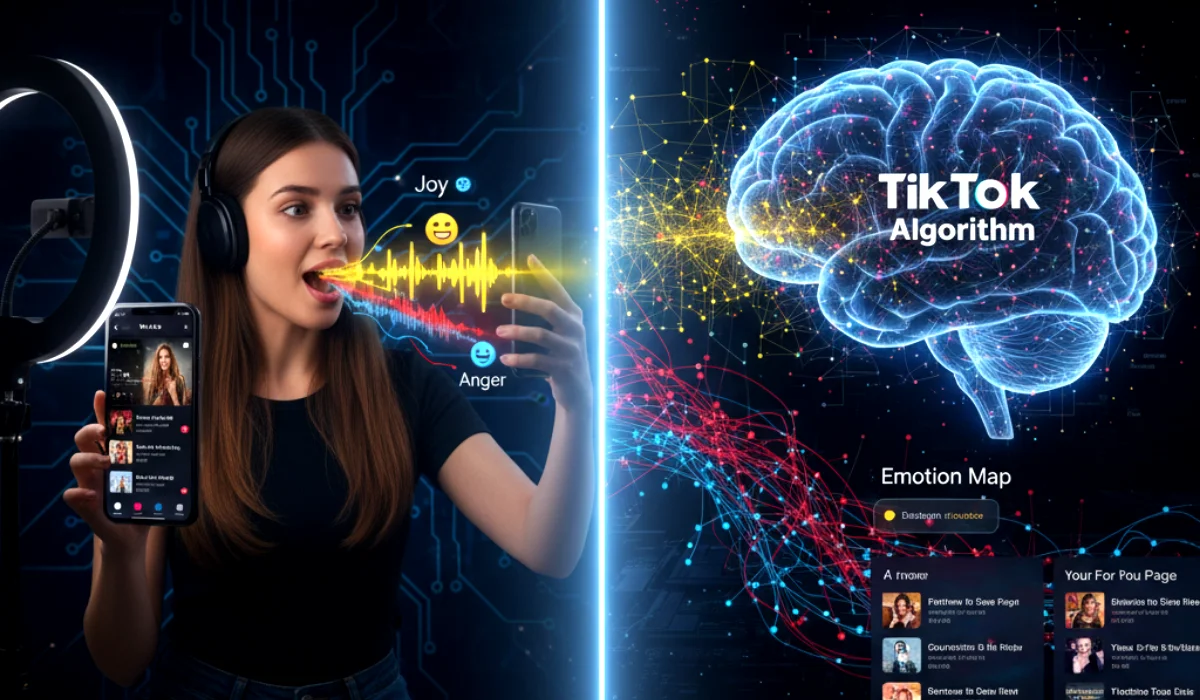
The leaked documents describe a new, powerful AI system that listens to the audio of every video, analyzes the emotional tone of the speaker’s voice, and assigns it an “Emotion Score.” This “Emotion Map” is then used to create a hyper-personalized feed designed to take you on an emotional journey, keeping you hooked for hours.
This is the secret behind TikTok’s seemingly magical ability to read your mind. The algorithm isn’t just watching you; it’s listening to the very soul of the content.
Expert Analysis: “This leak confirms what many of us in the data science community have suspected. TikTok has moved beyond explicit signals like ‘likes’ and ‘shares’ and into the realm of implicit emotional analysis. The ‘Emotion Map’ is revolutionary because it quantifies feeling. The AI isn’t just categorizing a video as ‘comedy’; it’s identifying the specific emotional frequency of the audio—joy, surprise, urgency, nostalgia—and using that data to predict what you’ll want to feel next. This is the holy grail of engagement, and it’s a quantum leap ahead of what Instagram and YouTube are doing.”
How It Works: The “Emotion Map” and Audio-Based Ranking
According to the leaked documents, the new algorithm is built on two groundbreaking pillars that work together to create the world’s most powerful recommendation engine.
1. Audio-Based Ranking: The AI is Listening
This is the core of the new system. For the first time, the audio of a video is allegedly as important, if not more important, than the visuals. The AI performs “prosody analysis” on every upload.
- What is Prosody Analysis? It’s the AI’s ability to listen to the way something is said, not just what is said. It analyzes:
- Pitch and Tone: Is the speaker’s voice high and excited, or low and calming?
- Pace: Are they speaking quickly with urgency, or slowly and deliberately?
- Volume: Are they whispering a secret or shouting with excitement?
- Why it Matters: This allows the AI to understand the true emotional intent of a video, even without visual cues. A video with a happy speaker will be categorized differently from one with a sad speaker, even if they are talking about the same topic.
2. The Emotion Map: Quantifying Feeling
Once the AI analyzes the audio, it assigns the video an “Emotion Score” and places it on a complex, multi-dimensional “Emotion Map.”
- What it is: Think of it as a fingerprint for the feeling of a video. Instead of simple tags like #funny or #sad, the AI creates a detailed emotional vector. For example, a video might be scored as:
- Joy: 92%
- Surprise: 78%
- Urgency: 45%
- Nostalgia: 15%
- The ‘For You’ Page Magic: The algorithm then uses this map to build your feed. If you’ve been watching a lot of videos with high “Joy” and “Surprise” scores, it will serve you more of the same. But it’s even smarter than that.
The Game-Changer: Predictive Emotional Sequencing
This is the most advanced and potentially manipulative part of the new algorithm. TikTok doesn’t just give you more of the same emotion. It tries to create an “emotional journey” to maximize your time on the app.
- How it Works: The AI predicts the optimal sequence of emotions to keep you engaged. For example, it might learn that after watching three funny videos (High Joy), you are most likely to engage with one heartwarming video (High Nostalgia/Sadness), followed by an exciting “life hack” video (High Urgency).
- The Flow State: By perfectly sequencing these emotional “hits,” the algorithm can guide users into a “flow state,” where time seems to disappear, and the impulse to scroll becomes almost subconscious. This is a key reason why the platform feels so addictive.
What This Means for Creators: Your Voice is Your New Viral Tool
For creators, this leak changes everything. Your visual style is still important, but your audio is now your primary tool for growth.
- Your Voice is the New SEO: A flat, monotonous vocal delivery will likely be down-ranked by the algorithm. An expressive, dynamic voice with varied pitch and pace will be rewarded. You must learn to “perform” with your voice, not just speak.
- Master the Emotional Hook: You need to consciously decide what emotion you want to evoke in the first two seconds of your video. That initial emotional signal is what the AI will latch onto.
- Sound Design is Non-Negotiable: The music, the sound effects, the moments of silence—every element of your audio contributes to the overall “Emotion Score.” Choosing a trending sound is no longer enough; the sound must match the emotional intent of your video.
The Dark Side: Emotional Manipulation and Algorithmic Control
The power to map and predict human emotion comes with profound ethical questions.
- Is TikTok a Mood Ring or a Mood Creator? If the algorithm knows what makes you happy, does it also know what makes you angry or sad? Could it intentionally keep you in a state of outrage to maximize engagement?
- The Governance Void: This level of sophisticated psychological profiling is happening with zero transparency or user consent. It highlights the urgent need for governments to understand and regulate these black box algorithms, a topic being debated with proposals like India’s National AI Firewall.
Conclusion: TikTok Isn’t a Video App Anymore
The 2025 algorithm leak, if true, confirms that TikTok has evolved. It is no longer a social media or video-sharing app. It is an emotion-delivery engine.
It has created a closed loop where it analyzes the emotional output of creators and sequences it perfectly to match the emotional needs of its users, creating the most addictive entertainment experience ever designed. For creators, the message is clear: stop thinking about what your video looks like, and start obsessing over what it feels like. In the age of the Emotion Map, your voice is your most powerful weapon.
Frequently Asked Questions (FAQs)
1. Is the TikTok algorithm leak real?
This information is based on unconfirmed documents. TikTok has not officially commented. However, the features described align with the known capabilities of modern AI and offer a plausible explanation for the platform’s powerful recommendation engine.
2. What is Audio-Based Ranking?
It is a system where the AI analyzes the emotional tone of the audio in a video (pitch, pace, volume) to understand its emotional intent and uses that as a key factor in ranking and recommending the video.
3. Does TikTok listen to my private conversations?
No. This leak refers to the AI analyzing the audio within the videos you watch and create on the platform. It does not refer to the app using your phone’s microphone to listen to your real-world conversations.
4. How can I optimize my audio for the new TikTok algorithm?
Focus on your vocal delivery. Speak with energy and vary your pitch and pace. Ensure your background music and sound effects match the emotion you want to convey. High-quality, clear audio is now more important than ever.
5. What is the “Emotion Map”?
It’s a theoretical model where the AI assigns a multi-dimensional “Emotion Score” (e.g., 92% Joy, 78% Surprise) to every video based on its audio and content, allowing for highly nuanced recommendations.
6. Will my old videos with bad audio be punished?
They won’t be “punished,” but they will likely be at a disadvantage compared to new videos that are highly optimized for emotional audio signals.
7. Is this algorithm ethical?
It raises significant ethical questions about emotional manipulation and the potential for a platform to influence a user’s mood for commercial gain.
8. How does this compare to the Instagram or YouTube algorithm?
This alleged system is far more advanced. While Instagram and YouTube primarily rely on user interactions (likes, watch time) and topic analysis, TikTok’s system appears to be analyzing a deeper, more subconscious layer of emotional response.
9. What is “prosody analysis”?
It is the linguistic term for analyzing the rhythm, stress, and intonation of speech. In this context, it’s how the AI listens to the music of your voice, not just the words.
10. Do viral sounds matter anymore?
Yes, but context is now key. Using a trending sound is not enough. The emotion of the trending sound must align with the emotion of your video content to be effective.
11. Does this mean my video’s visuals are not important?
Visuals are still very important for grabbing initial attention. However, this leak suggests that audio quality and emotional tone are now equally, if not more, important for retention and recommendation.
12. How can I learn to be more expressive with my voice?
Practice recording yourself and listening back. Take inspiration from voice actors or radio hosts. Focus on speaking from the diaphragm and conveying energy through your voice.
13. What is “predictive emotional sequencing”?
It’s the theory that the algorithm doesn’t just show you random videos but intentionally creates a sequence of videos with different emotions (e.g., funny -> sad -> surprising) to keep you in a state of high engagement.
14. Will this make TikTok even more addictive?
Yes, a system designed to perfectly cater to and guide your emotional state is, by its very nature, going to be more addictive.
15. Can I turn off the emotion tracking?
No. This is a core part of the content recommendation system. There is no user-facing setting to control it.
16. How will this affect advertisers on TikTok?
This could be a goldmine for advertisers, allowing them to target users based on their current emotional state, leading to hyper-effective ad campaigns.
17. How can I check the “Emotion Score” of my video?
You can’t. This is an internal metric used by the algorithm and is not visible to creators.
18. Will this change the type of content that goes viral?
Yes. It will likely favor content with clear, strong emotional signals. Content that is emotionally ambiguous or has a flat, monotonous audio track may struggle to get traction.
19. Does this apply to silent videos or videos with only music?
For videos with only music, the AI would analyze the emotional qualities of the music itself (e.g., tempo, key, instrumentation). For truly silent videos, the algorithm would have to rely on visual and engagement signals, but these videos would be at a disadvantage.
20. What’s the number one takeaway for creators?
Treat your audio like it’s the most important part of your video. Your voice is now a direct line to the TikTok algorithm.