


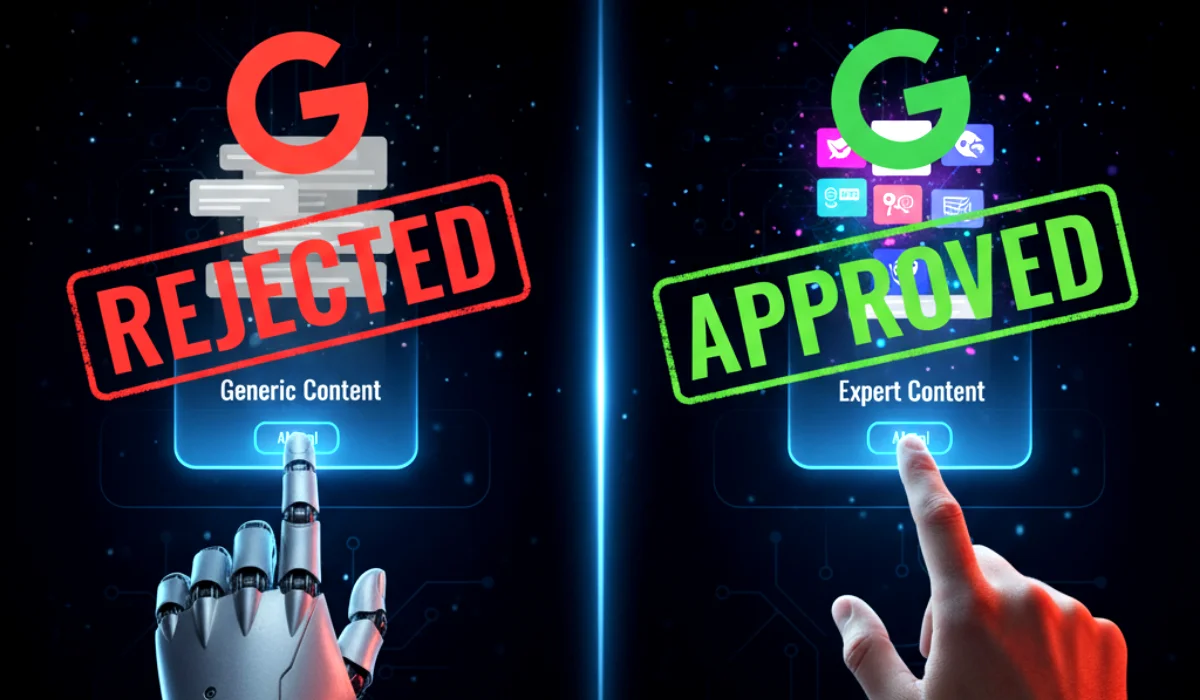
You’ve seen your traffic plummet, your rankings disappear, and you’re starting to believe the whispers in forums and social media groups—that Google has an “AI detector” and is systematically punishing anyone who uses artificial intelligence to write articles.
Let’s be perfectly clear: Google is not punishing you for using AI.
It’s punishing you for being lazy.
The hard truth is that Google’s algorithms have become incredibly adept at identifying low-quality, low-effort content, and the explosion of generative AI has simply made it easier to create this type of content at an unprecedented scale. You’re not being penalized for using a tool; you’re being penalized for the low-quality output that the tool makes it easy to produce.
The game has changed. High-quality content, infused with genuine experience and expertise, still ranks, regardless of whether AI assisted in its creation. This is the full analysis of how Google is catching low-effort content and how you can use AI the right way to stay on top.
Expert Analysis: “The panic around AI penalties is misdirected. Google’s core mission has always been to eradicate worthless content, and for years, that meant fighting human content farms. Now, it means fighting AI content farms. The AI isn’t the problem; the lack of human experience is. We’re seeing that Google’s ‘Quality Signal Score’ is now heavily weighted towards content that demonstrates first-hand knowledge. If your article reads like a generic summary of the top 10 search results—which is what most basic AI prompts produce—you will be demoted, not because an ‘AI detector’ flagged you, but because you provided zero new value to the user.”
How Google’s AI Catches Low-Quality AI Content
Google doesn’t need a magic “AI detector.” Its existing quality algorithms have evolved to spot the tell-tale fingerprints of generic, unhelpful content.
1. The “Experience” Vacuum (E-E-A-T Collapse)
This is the single biggest factor. The ‘E’ for Experience in E-E-A-T is now paramount. AI models have not lived life. They cannot share a personal story, a case study, or a hands-on review.
- The Red Flag: Content that is purely descriptive and lacks any unique anecdotes, personal opinions, or first-hand accounts. It explains what something is but never shows that the author has actually done it. This is one of the primary real causes of the recent Google traffic drops.
2. The Repetitive Semantic Fingerprint
AI models, even advanced ones, have a tendency to fall back on certain patterns, sentence structures, and vocabulary.
- The Red Flag: Articles that overuse transition phrases like “In conclusion,” “Furthermore,” and “It’s important to note.” The content has a certain “smoothness” and lack of a unique authorial voice. Google’s AI is a master of language patterns, and it can easily spot text that lacks the slightly messy, unique fingerprint of human writing. This is why you must know how to spot AI-written content in your own workflows.
3. The “Information Gain” Failure
Google’s goal is to reward content that adds new information to the web.
- The Red Flag: Most basic AI-generated articles are just a re-aggregation of information that already exists in the top 10 search results. They provide no “information gain.” If your article doesn’t contain a new piece of data, a unique perspective, or a novel case study, Google’s AI sees it as redundant and worthless.
4. The “Journey” Dead End
As we’ve discussed, Google’s new “Journey Algorithm” rewards websites that can guide a user through a topic.
- The Red Flag: Generic AI articles are often created in isolation. They are “one-hit wonders” that don’t connect to a broader content ecosystem. They are a dead end for the user’s journey, which is a major negative signal to the new Discover algorithm.
The Proof: How to Use AI and Still Rank in 2025
So, is all AI content doomed? Absolutely not. AI is a tool, like a hammer. You can use it to build a house, or you can smash your thumb. The key is to use AI as an assistant, not a replacement for your brain.
High-quality content that ranks still uses AI, but it’s used strategically:
- For Ideation and Outlining: Using AI to brainstorm article ideas, create detailed outlines, and perform initial keyword clustering is a huge time-saver.
- For Research Summarization: Using AI to read and summarize 20 different sources on a topic to help you quickly understand the landscape.
- For Improving Readability: Using AI to check for grammar, simplify complex sentences, and improve the overall readability and optimization of your content.
- For First Drafts (That You Heavily Edit): Using AI to generate a rough first draft, which the human expert then completely rewrites, injects with personal experience, adds unique data, and refines with their own voice.
In this model, the AI does the grunt work, but the core value—the expertise, the experience, the unique insight—comes from the human. Google cannot and will not penalize this.
Conclusion: Stop Blaming the Tool, Start Improving the Output
The panic over AI penalties is a distraction from the real issue. Google is not waging a war on AI; it is waging a war on bad content.
If your traffic has dropped, don’t blame the AI. Blame your process. Audit your content and be brutally honest. Does it sound like it was written by someone who has actually lived what they are writing about? Does it offer a unique perspective that can’t be found anywhere else? Does it add real value to the internet?
If the answer is no, then the problem isn’t the tool you’re using. The problem is the content you’re creating. In the age of AI, genuine human expertise is not just valuable; it’s the only thing that will survive.
Frequently Asked Questions (FAQs)
1. Can Google definitively detect AI-generated content?
No, there is no perfect “AI detector.” However, Google’s AI is extremely good at detecting the qualities of low-effort, generic content, which is often produced by AI. It penalizes the lack of quality, not the tool used to create it.
2. Will I get a manual penalty for using AI?
No. Google has repeatedly stated that its policy is to reward quality content, regardless of how it is produced. You will not get a manual penalty for “using AI,” but you will be algorithmically demoted for publishing unhelpful, low-quality content.
3. Is it safe to use tools like ChatGPT or Jasper for content?
Yes, it is safe to use them as tools to assist your writing process. It is not safe to copy and paste their output directly and publish it without significant editing and the addition of your own unique experience.
4. How much do I need to edit AI content to make it “safe”?
There is no magic percentage. The goal is to transform it. The final piece should be infused with your unique voice, first-hand experiences, and insights that the AI could not have produced on its own. If you can’t tell it was originally from an AI, you’re on the right track.
5. What is the biggest red flag for AI-generated content?
A complete lack of personal experience. The content describes a topic perfectly but contains no stories, no “I tried this and here’s what happened,” no unique case studies, and no personal opinions.
6. Can AI help with my E-E-A-T?
No. AI can write about a topic, but it cannot have first-hand “Experience.” It cannot be a recognized “Expert,” and it cannot build “Authoritativeness” or “Trustworthiness” on its own. Only a human can provide these signals.
7. How can I “inject experience” into my content?
Use personal anecdotes. Include your own photos or videos. Reference specific data from your own work. Talk about mistakes you’ve made. Share what you learned from a real-world project.
8. Is shorter AI content safer than longer content?
No. The length is irrelevant. A short, 300-word paragraph that shares a genuine, unique tip is far more valuable than a 5,000-word generic, AI-generated “ultimate guide.”
9. My competitor is using AI and ranking. Why?
They are likely using AI as a tool to assist human experts who are then heavily editing and adding their own value, or they simply haven’t been caught by the algorithm yet. The demotion will eventually come if the quality is not there.
10. What is “Information Gain”?
It’s an SEO concept that refers to providing new, unique information that is not present in the existing search results. Content with high information gain is highly valued by Google.
11. Is it better to write fewer, high-quality articles?
Yes, absolutely. In the current environment, one exceptional, in-depth article that demonstrates true expertise is worth more than 100 generic, low-quality articles.
12. How does this relate to the ‘Helpful Content Update’?
This is the logical evolution of the Helpful Content Update. Google is simply getting better at algorithmically identifying what is truly “helpful,” and that increasingly means content created for humans, by humans with real experience.
13. Can AI write product descriptions or other short-form content?
Yes, AI is excellent for this kind of task, as it is more formulaic. Using AI for product descriptions, meta descriptions, or social media posts is generally very safe and efficient.
14. What if I disclose that the content is AI-generated?
Disclosure is good for transparency with your readers, but it will not save you from an algorithmic demotion. Google ranks content based on its quality and helpfulness, not on a disclosure tag.
15. My site has a mix of human and AI content. What should I do?
Conduct a content audit. Identify your low-quality, generic AI articles and either significantly improve them by adding human experience or delete them and redirect the URL to a more relevant, high-quality page.
16. Does using AI to fix grammar or spelling count as “AI content”?
No. Using tools like Grammarly or the built-in editors in Google Docs is perfectly safe and is considered a standard part of the writing process.
17. What is the “Semantic Fingerprint”?
It refers to the subtle, often repetitive patterns in word choice and sentence structure that AI models tend to use. A human writer’s “semantic fingerprint” is naturally more varied and unique.
18. I’m not an expert in my niche. Can I still rank?
It will be very difficult. The current algorithm is heavily skewed towards rewarding proven expertise. Your best bet is to either become a true expert yourself or hire recognized experts to write for your site.
19. How can I prove my expertise to Google?
Through your content. Write in-depth case studies. Publish original research. Show, don’t just tell. A detailed author bio, social proof, and links from other authoritative sites in your niche also help.
20. What is the one thing I should stop doing right now?
Stop publishing content that you haven’t personally reviewed, edited, and infused with your own unique human perspective. The era of “publish and pray” with raw AI output is over.