


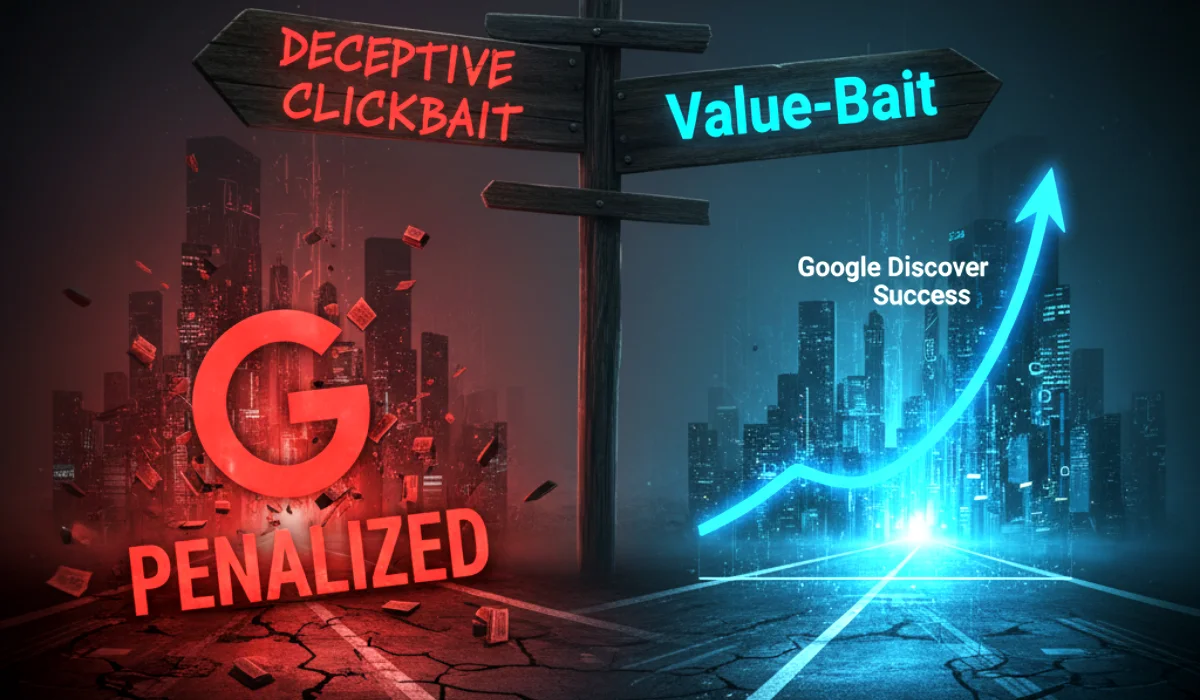
It’s the ultimate temptation for every content creator: the clickbait title. A headline so irresistible, so packed with curiosity and intrigue, that users can’t help but click. For years, this was the undisputed king of driving massive, spiky traffic from Google Discover.
But that was then.
Now, in 2025, you’re hearing a different story. You’ve seen your own traffic collapse, and you’re wondering if your edgy headlines are to blame. So, what’s the truth? Do clickbait titles still work?
The honest answer is both yes and no. Classic, deceptive clickbait is dead, and using it will get your site penalized. However, the psychology of clickbait is more powerful than ever.
The new king is “Value-Bait”—a headline that makes a huge, intriguing promise and then over-delivers on that promise in the content. Google’s AI no longer rewards you for winning the click; it rewards you for satisfying the user after the click. Understanding this distinction is now the single most important factor for Discover success.
Expert Analysis: “The game has fundamentally changed. Google’s AI now operates on a ‘trust violation’ model. A clickbait headline is a promise. When a user clicks and the content doesn’t fulfill that promise, the AI registers a trust violation. Rack up enough of these violations, and your site’s ‘Quality Signal Score’ plummets, leading to a total suppression from Discover. The algorithm isn’t just measuring CTR anymore; it’s measuring the ‘Click-to-Satisfaction Ratio.’ If your satisfaction score is low, your traffic will be zero.”
The Old Clickbait vs. The New “Value-Bait”
The line is subtle but critical. One gets you penalized, the other gets you rewarded.
The Old Way (Deceptive Clickbait) – DO NOT DO THIS
- Headline: You Won’t Believe What This Celebrity Looks Like Now!
- Content: A 20-page slideshow with one blurry photo per page, surrounded by ads.
- Result: A high initial CTR, followed by a massive bounce rate. The user feels tricked. Google’s AI registers a “trust violation” and a content mismatch penalty. Your site gets demoted.
The New Way (“Value-Bait”) – THE 2025 STRATEGY
- Headline: Your Google Discover Traffic Didn’t Just Drop. It Was Pushed Off a Cliff. Here’s Why.
- Content: An in-depth, 2,000-word article that directly addresses the reader’s pain point, explains the complex new “Journey Algorithm,” and provides actionable solutions.
- Result: A high CTR driven by a powerful, relevant hook. The user stays, reads, and might even click an internal link to learn more. The user feels satisfied and empowered. Google’s AI registers a high “Click-to-Satisfaction Ratio” and a strong “Journey Score.” Your site gets promoted.
Why Deceptive Clickbait Now Gets You Penalized
Google’s AI has become incredibly sophisticated at detecting user dissatisfaction. It’s no longer just about the click.
1. It Measures “Pogo-Sticking”: The AI tracks when a user clicks your article in Discover and then immediately hits the back button to return to the feed. This is a massive negative signal that your content did not deliver on the headline’s promise.
2. It Analyzes Post-Click Engagement: Does the user scroll down the page? Do they spend more than 30 seconds reading? Do they click any internal links? A lack of post-click engagement tells Google your content was a dead end.
3. It Understands Semantic Mismatch: Google’s AI can now semantically analyze your headline and your body content to see if they align. If your headline is about a “secret hack” but your content is a generic list of tips, the AI knows you’ve created a mismatch. This is especially true if you’re using AI to generate thin content, a practice Google is actively punishing when it lacks quality.
How to Use “Value-Bait” to Win on Discover in 2025
You can still use the powerful formats of clickbait, as long as you provide immense value.
1. The Hyper-Specific Listicle:
- Old Way: 10 Ways to Be More Productive. (Generic)
- New Way: The 5 ‘Silent Killers’ That Are Actually Destroying Your Google Traffic. (Specific, targets a pain point, promises a revelation).
2. The Intriguing Question:
- Old Way: Should You Use AI? (Boring)
- New Way: Is Google Actively Punishing AI-Generated Content? An Analysis With Proof. (Intriguing, confrontational, promises an expert answer).
3. The Bold Statement + Payoff:
- Old Way: SEO is Important. (Obvious)
- New Way: Your Clickbait Titles Are Getting Your Site Penalized. Here’s How to Fix It. (A bold claim that directly addresses the reader, followed by a promise of a solution).
The key to all of these formats is that the content must be exceptional. It must have high utility and be written with a clear, authoritative voice to improve its readability and optimization.
Conclusion: The Click is Cheap, Trust is Everything
Stop asking if clickbait works. Start asking if your content works.
A catchy, high-CTR headline is still a vital part of the equation, but it’s just the first step. In the new Google Discover ecosystem, your headline writes a check that your content must cash. If you can’t deliver on the promise, not only will you not get the traffic, but you will actively harm your site’s reputation with Google.
The click is cheap. The user’s trust is the new currency. Create headlines that are irresistible, but follow them with content that is indispensable. That is the only formula that works in 2025.
Frequently Asked Questions (FAQs)
1. Will I get a manual penalty for a clickbait title?
No, it’s typically an algorithmic demotion. Your site will just stop receiving Discover traffic.
2. What is a good CTR for Google Discover?
A good CTR is typically considered to be 8-12% or higher, but this metric is now less important than post-click engagement.
3. Is it better to have a boring headline and great content?
No. You need both. A boring headline means no one will ever see your great content. The key is a great headline followed by great content.
4. How quickly can Google penalize you for this?
The system is automated and fast. The AI can detect a pattern of high CTR followed by low engagement within a day or two and suppress the article.
5. How can I fix a site that has been penalized for clickbait?
You must go through your top articles and rewrite the headlines and introductions to be a more honest representation of the content. Then, focus on publishing new articles that follow the “Value-Bait” model. It can take months to recover from a perceived quality penalty.
6. Are question-based titles still good for SEO?
Yes, they are excellent, as long as your article comprehensively answers the question. They align perfectly with what users are searching for.
7. Does using numbers in headlines still work?
Yes, listicles are still a powerful format. “The 7 Reasons Why…” works because it sets a clear expectation for the reader, which helps build trust.
8. Is it okay to have a strong, controversial opinion in my headline?
Yes, as long as you back it up with strong arguments and evidence in your article. A strong opinion with weak proof is just another form of a trust violation.
9. My site has a high bounce rate. Is that why I’m not on Discover?
It’s a major factor. A high bounce rate tells Google that users are not finding what they expected, which is often a symptom of a headline-content mismatch.
10. Where do you draw the line between a catchy headline and clickbait?
The line is user satisfaction. A catchy headline makes a user curious. A clickbait headline makes a user feel tricked.
11. How does E-E-A-T relate to clickbait?
A clickbait headline on a site with weak E-E-A-T is a huge red flag for Google. It suggests the site is trying to generate traffic without having any real expertise or authority to back it up.
12. Can I test different headlines for the same article?
Yes, this is a great practice. Use A/B testing tools to see which “Value-Bait” headline generates the best combination of high CTR and high on-page engagement.
13. What is “pogo-sticking”?
It’s when a user clicks a result, finds it unhelpful, and immediately clicks the “back” button to return to the search or Discover feed to choose another result. It’s a major negative signal.
14. Is it bad to use emotional words in headlines?
No, emotional words (e.g., “shocking,” “powerful,” “secret”) can be very effective, but only if the content genuinely delivers an emotional impact. Overusing them without payoff will be seen as deceptive.
15. My traffic is fine. Should I still change my headlines?
If it’s not broken, don’t fix it. However, you should audit your top-performing Discover articles and ask yourself if they truly deliver on their promise. It’s better to be proactive.
16. Are there any tools to help write better headlines?
AI tools can be great for brainstorming different angles and formats, but a human must make the final decision to ensure the headline is both catchy and honest.
17. What is a “trust violation” in Google’s eyes?
It’s any instance where the user’s expectation, set by the headline and image, is not met by the content. It breaks the trust between the user and Google’s recommendation.
18. Why does my competitor get away with clickbait?
They might have a very high domain authority that temporarily shields them, or their penalty just hasn’t been applied yet. It’s not a sustainable long-term strategy.
19. Should my headline be a full sentence?
Not necessarily. It should be a complete, compelling thought. Sometimes fragments or questions are more powerful.
20. What is the most important takeaway from this?
Your headline and your content are not two separate things. They are a single package. A great headline promises value. Great content delivers it. You must do both to succeed.