


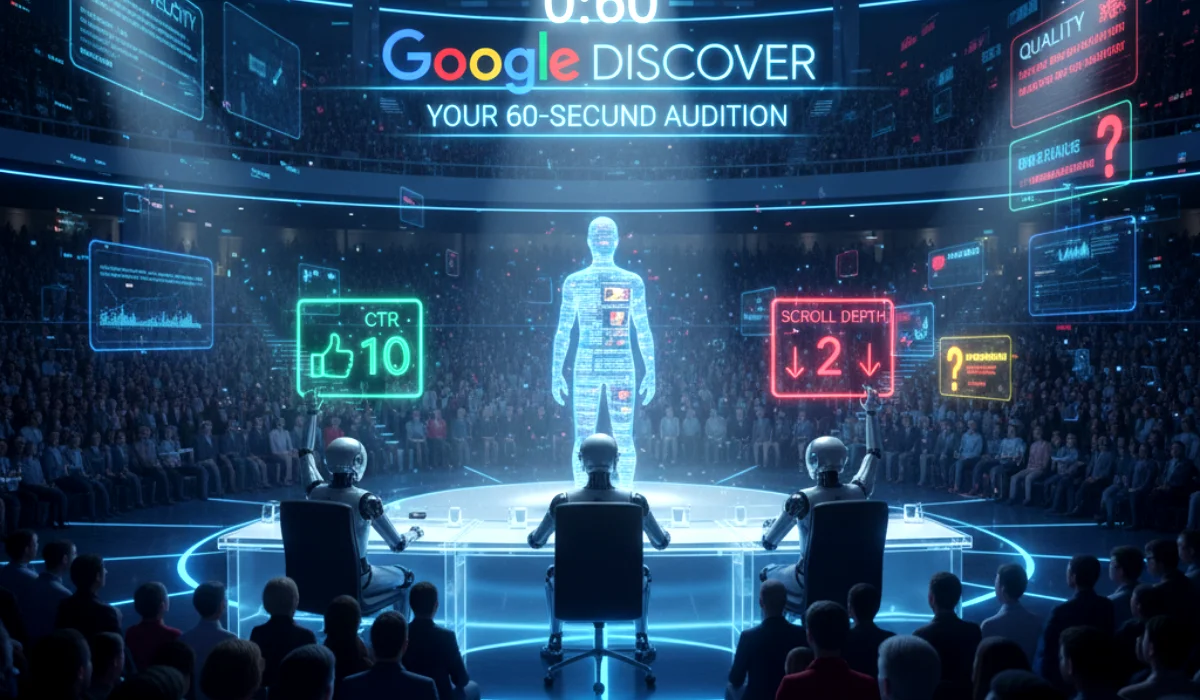
It’s the billion-dollar question that’s keeping publishers awake at night: How does the Google Discover algorithm really work in real-time?
You’ve seen it happen. An article gets a sudden, explosive surge of traffic from Discover, only to vanish from the feed an hour later without a trace. Another article sits dormant for days, then suddenly goes viral. What’s happening behind the scenes?
Since mid-2025, Google has rolled out a series of unexplained, highly dynamic real-time signals that have turned the Discover feed into a live, minute-by-minute battle for relevance. The old rules of just publishing a good article and waiting are dead.
While Google has remained tight-lipped, a clear pattern has emerged from the data. This is the unofficial guide to the real-time ranking signals that SEO experts are now seeing—the hidden mechanics that decide if your content goes viral or disappears into the void.
Expert Analysis: “Discover is no longer a curated list; it’s a living ecosystem that responds to user signals in seconds. We’re seeing articles get ‘micro-bursts’ of impressions. The AI shows the article to a small test audience, and if it fails to meet a real-time engagement threshold—what we call ‘Click-to-Satisfaction’—it’s pulled from the feed almost instantly. The window to prove your content’s value has shrunk from days to minutes. It’s a brutal, but brilliant, system.”
The 6 Real-Time Signals Deciding Your Fate
This is what’s happening behind the curtain. Mastering these six signals is the key to winning on Discover in this new, dynamic era.
1. Real-Time Content Velocity
This isn’t just about the freshness of your article; it’s about the freshness of the topic.
- What It Is: “Content Velocity” refers to how quickly you publish a high-quality piece of content after a new topic begins to trend. When a new AI model is announced or a major event happens, there’s a brief “authority vacuum.” The first site to publish a genuinely helpful, in-depth explanation captures the initial wave of user interest.
- How to Win: Don’t just report the news. Explain what it means. Your goal is to be the first comprehensive resource, not the first to break the headline. This is a core tenet of the new “Journey Algorithm”.
2. The Visual Engagement Score
Your featured image is no longer just a thumbnail; it’s a data point.
- What It Is: Google’s AI is performing real-time analysis on your featured image, scoring it for clarity, composition, human faces, and emotional resonance. A generic stock photo gets a low score. A unique, compelling, and emotionally charged image gets a high score.
- How to Win: Your image must tell a story on its own. It should create a “curiosity gap” that complements the headline. A powerful image can significantly boost your initial CTR, which is the first test your article must pass.
3. Click-Through Rate (CTR) as the ‘Audition’
Your headline and image package is your audition for Discover. A high CTR gets you in the door.
- What It Is: When your article is first shown, it’s to a small test audience. If it achieves a high CTR, the AI takes this as a strong positive signal and widens the audience. If it has a low CTR, it’s often pulled from the feed immediately.
- How to Win: Your headline must be both intriguing and valuable. This is where “Value-Bait” comes in. As we’ve covered, the goal is not deceptive clickbait, which can get you penalized. The goal is a powerful headline that makes a promise your content can deliver on.
4. The Dwell Time vs. Scroll-Depth Debate: Scroll Depth Wins
For years, “dwell time” (how long a user stays on a page) was a key metric. This is no longer true for Discover.
- What It Is: The AI has realized that a user can have a tab open for 10 minutes (high dwell time) without reading a single word. A far stronger signal of engagement is “scroll depth.” Did the user scroll 70%, 80%, or all the way to the bottom of the article?
- How to Win: Your article’s introduction is the most critical part. It must hook the reader and convince them to start scrolling. Break up your text with images, subheadings, and blockquotes to encourage scrolling. A user who scrolls to the end, even in 90 seconds, is a much stronger positive signal than a user who stays for 5 minutes but never gets past the first paragraph.
5. Live AI Quality Validation
This is the final, and most brutal, real-time test.
- What It Is: After the click, Google’s AI is validating the quality of your content in real-time. If a significant percentage of users who click your article from Discover immediately “pogo-stick” back to the feed, the AI flags this as a major “trust violation.” It’s a sign your content failed to deliver on the headline’s promise. This can cause your article to be removed from the feed within minutes.
- How to Win: Your content must be exceptionally helpful and well-structured. This is why publishing generic, low-effort AI-generated content is so risky; it can’t satisfy this live quality check.
6. The Web Stories Multiplier
Google Web Stories are not treated like normal articles. They are a native Discover format and operate under a slightly different set of rules.
- What It Is: Web Stories are designed for rapid, visual consumption. They get preferential treatment and often have a much higher CTR in the feed. They can act as a powerful “top-of-funnel” tool.
- How to Win: Use Web Stories as a “gateway drug” to your main content. Create a visually compelling story that summarizes a topic and then links to your in-depth article. This allows you to leverage the high visibility of Stories to drive users into your more comprehensive “Journey” content.
Conclusion: Discover Is a Live Performance, Not a Library
Stop thinking of Google Discover as a library where you place a book on a shelf and hope someone finds it. It’s a live stage, and your article is a performance.
You have seconds to capture the audience’s attention with your visuals and headline (CTR). You have minutes to keep them engaged and scrolling (Scroll Depth). If you succeed, your performance is shown to a larger and larger audience. If you fail, you are pulled off the stage.
Success in this new environment requires a complete shift in mindset—from static publishing to dynamic performance optimization. Master these real-time signals, and you can master the Discover feed.
Frequently Asked Questions (FAQs)
1. How can I measure my “Content Velocity”?
You can’t directly measure it, but you can be aware. Use tools like Google Trends and monitor industry news. When a new topic emerges, make it a priority to publish a comprehensive “explainer” piece as quickly as possible.
2. What makes a good “Visual Engagement Score”?
Unique, high-resolution images that feature people, evoke emotion, or create a strong sense of curiosity. Avoid generic stock photos at all costs.
3. What is a good CTR to aim for on Discover?
While it varies by niche, a CTR above 10% is generally considered strong and will likely pass the initial “audition.”
4. Is a 30-second visit with 90% scroll depth better than a 3-minute visit with 20% scroll depth?
Yes, almost certainly. The deep scroll indicates the user was actively consuming and engaged with the content, which is a much stronger positive signal.
5. My article went viral and then disappeared. What happened?
It likely passed the initial CTR test but failed the “Live AI Quality Validation.” Users clicked, but they didn’t find the content helpful and bounced back to the feed, causing the AI to pull it. This is a classic sign of a content mismatch penalty.
6. Do I need to create Web Stories for every article?
No, that’s not scalable. Use Web Stories for your most important, visually-driven “pillar” content to act as an entry point to your topic clusters.
7. How can I track the scroll depth of my articles?
You can set up scroll depth tracking in Google Analytics 4 (GA4) using Google Tag Manager. This is now an essential metric to monitor.
8. Will a slow website fail these real-time tests?
Absolutely. A slow-loading page will cause users to bounce before the content even appears, leading to near-zero scroll depth and an instant failure of the quality validation test.
9. How does E-E-A-T factor into these real-time signals?
E-E-A-T is the foundation. A site with strong, established E-E-A-T is more likely to be chosen for the initial “micro-burst” test audience in the first place. Without it, you may never even get the chance to perform. Getting approved by Google News is a good sign of baseline trust.
10. Is it better to update old articles or write new ones for “Content Velocity”?
Both are valid. If you have a relevant existing article, updating it with the new information can be very fast and effective. If the topic is entirely new, a new article is necessary.
11. How do I create a “curiosity gap” without being deceptive clickbait?
Pose a question in your headline that the user genuinely wants to know the answer to and that your article clearly answers. Example: “Why New Sites Go Viral on Discover (While Your Old Site Dies).”
12. Can a bad comment section affect my Discover performance?
Indirectly, yes. A toxic or spammy comment section can hurt user experience and may contribute to a lower overall quality score.
13. Does Google Discover use my personal browsing history?
Yes, Discover is a hyper-personalized feed based on the topics and entities Google knows you are interested in from your search history, YouTube history, and other Google activity.
14. My traffic is very inconsistent. Is this normal for Discover?
Yes, Discover traffic is notoriously volatile because it is event-driven and interest-based, not query-based like search. However, sites with strong topical authority tend to have more stable Discover traffic.
15. If my article is pulled, can it come back?
Yes. If you update the article to improve its quality, headline, or image, it can be re-evaluated by the algorithm and may reappear in the feed.
16. What is the best format for Discover articles?
There is no single “best” format. However, well-structured listicles, in-depth explainers, and strong narrative stories tend to perform well because they encourage scrolling.
17. Do I need to use structured data (Schema) for Discover?
Yes. Article, NewsArticle, Author, and ImageObject schema are all critical for helping Google understand your content and display it correctly.
18. How often does the Discover algorithm change?
The underlying principles change slowly, but the real-time signals are constantly being evaluated. Think of it as a living system that is always learning and adjusting.
19. What is the biggest mistake people make with Google Discover?
They treat it like Google Search. They focus on keywords instead of user interests and journeys. Discover is a recommendation engine, not a search engine.
20. What is the single most important action I can take today?
Go to your analytics. Find an article with a high CTR but a low average engagement time. This is your “leaky bucket.” Read the introduction and first few paragraphs and be honest: would you keep scrolling? If not, rewrite it until the answer is yes.