


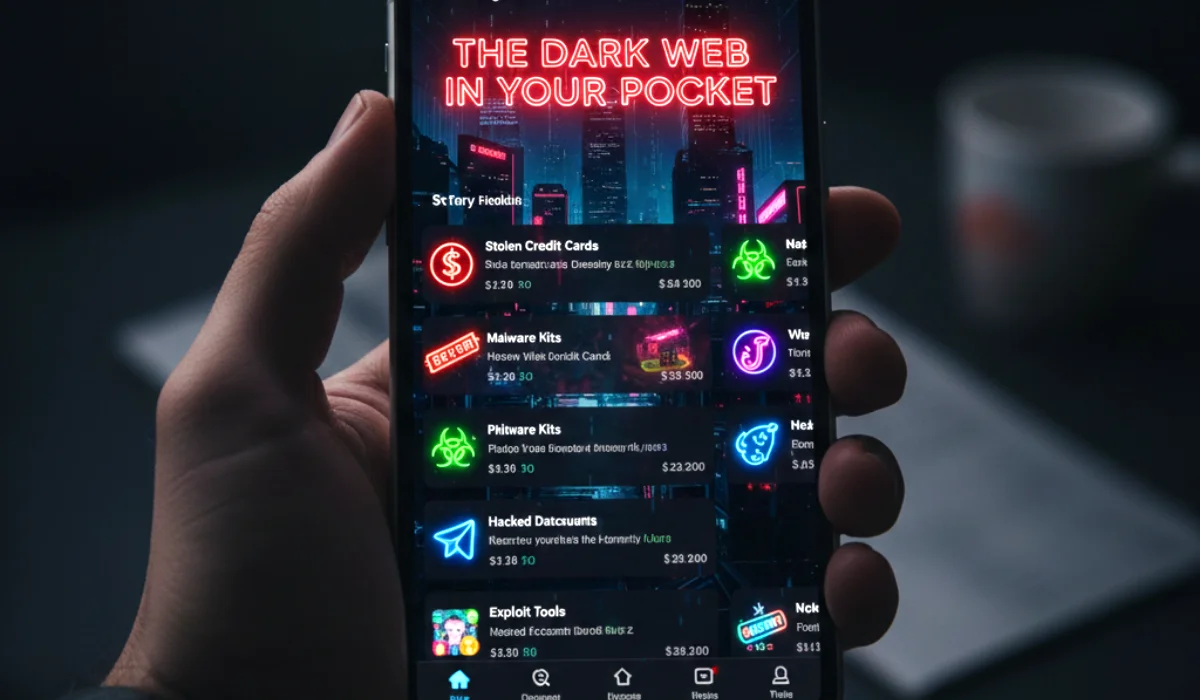
For years, when we thought of a bustling black market for stolen data, we pictured the dark web—a shadowy, inaccessible realm requiring special browsers and technical know-how. We imagined clandestine forums hidden behind layers of encryption. But in 2025, that picture is dangerously outdated. A significant portion of the cybercrime economy has migrated from the shadows of the dark web to an app you might have on your phone right now: Telegram.
Security researchers have dubbed it “the dark web in your pocket.” This mainstream messaging app, known for its privacy features and massive user base of nearly one billion, has become the de facto superstore for cybercriminals. It’s faster, easier, and in many ways, more efficient for business than the old forums.
This isn’t a story about secret hacker back-channels. This is the story of how a legitimate, widely-used application became the public-facing front for a thriving criminal ecosystem, where stolen credit cards, malware, and entire personal identities are traded as openly as products on Amazon. Based on public reports from cybersecurity firms and intelligence analysts, this is the inside story of how Telegram became the new hub for cybercrime.
Disclaimer: This article is for educational and public safety purposes only. The activities described are illegal. This information is intended to raise awareness of the threats that exist on public platforms so that users and businesses can better protect themselves.
The Great Migration: Why Criminals Are Leaving the Dark Web for Telegram
The allure of the traditional dark web was always anonymity. However, it was also slow, clunky, and required technical expertise to navigate. Law enforcement takedowns of major marketplaces like Silk Road and AlphaBay proved that it wasn’t the untraceable haven criminals believed it to be. Cybercriminals, ever the entrepreneurs, sought a platform that offered a better business model. They found it in Telegram.
Here’s why the migration happened:
- Massive User Base & Accessibility: The dark web has a few million users. Telegram has nearly a billion. Criminals no longer have to wait for buyers to come to their hidden corner of the internet; they can market their illicit goods to a colossal, built-in audience. It’s the difference between setting up a shop on a deserted island versus opening a store in Times Square.
- Ease of Use & Superior Features: Unlike the archaic forums of the dark web, Telegram is a modern, feature-rich app. It supports large file sharing, high-quality images and videos for “product” showcases, and public channels that can host up to 200,000 members. It’s simply a better e-commerce platform.
- The Power of Channels: Public Telegram channels are the new storefronts. A criminal can create a channel, generate an invite link, and instantly have a platform to advertise their goods. There’s no need to register a domain or set up a server, which hardens their operation against the DDoS attacks that frequently take down dark web sites.
- Automation with Bots: Telegram’s powerful API allows for the creation of sophisticated bots. These bots can automate the entire sales process, from answering customer questions and processing payments to delivering the stolen data or malware instantly. This creates a highly efficient, “vending machine” model for cybercrime.
While the dark web is still used for highly sensitive communications and top-tier criminal activity, Telegram has become the bustling, accessible “retail” layer of the cybercrime economy. As we previously explored, the process of buying leaked databases involved navigating a complex ecosystem; Telegram has streamlined that process into a few simple clicks.
The Telegram Black Market: A Breakdown of the Ecosystem
The cybercrime ecosystem on Telegram isn’t just one giant channel; it’s a network of specialized marketplaces, each focusing on a different illicit product or service.
1. The Data & “Logs” Supermarkets
These are the most common type of criminal channel. They specialize in selling “logs”—the bundles of data stolen from infected computers.
- What’s For Sale: A typical log contains everything from the victim’s browser cookies and saved passwords to their credit card details and cryptocurrency wallet files.
- How it Works: Sellers advertise logs from specific countries or with access to specific services (e.g., “US Log with Amazon & Banking Access”). Prices can range from a dollar for a simple social media account to hundreds for a verified corporate or banking login. The transaction is often handled by a bot that releases the data file after a cryptocurrency payment is confirmed.
2. Phishing-as-a-Service (PhaaS) Kits
Why learn to phish when you can rent a professional kit? Telegram is flooded with channels that sell everything needed to launch a sophisticated phishing campaign.
- What’s For Sale: These channels offer complete “phishing kits” that include branded email templates (e.g., a fake Microsoft “suspicious login” alert), professionally designed credential-harvesting websites, and the backend infrastructure to capture the stolen data.
- How it Works: The most advanced kits use Telegram bots for data exfiltration. When a victim enters their password into the fake website, the bot instantly sends the credentials directly to the attacker’s private Telegram chat, allowing for account takeover in seconds.
3. Malware & Hacking Tool Depots
These channels function as illegal software stores, providing malware for aspiring and veteran hackers.
- What’s For Sale: Remote Access Trojans (RATs) like DarkMe, spyware, ransomware kits, and DDoS-for-hire services are all on the menu. These tools are often sold via a subscription model, complete with customer support and regular updates.
- How it Works: Attackers often use other Telegram channels, perhaps those focused on trading or cryptocurrency, to distribute their malware. They’ll post a seemingly legitimate file (like a “trading tool” or a “new crypto wallet”), which, when opened, infects the user’s device.
4. Financial Fraud & Carding Forums
These are channels dedicated to credit card fraud, also known as “carding.”
- What’s For Sale: Stolen credit card numbers (CVVs), “fullz” (full identity packages for creating fraudulent accounts), and money laundering services.
- How it Works: Sellers post lists of card numbers with their associated details (expiration date, CVV, cardholder name, and ZIP code). Buyers purchase these to make fraudulent online purchases. Other channels specialize in “cashing out” by offering services to convert stolen financial data into untraceable cryptocurrency.
The “Inside Story”: Law Enforcement and the Crackdown
For a long time, Telegram’s stance on privacy and its encrypted nature made it seem like a safe haven. However, the sheer scale of the criminal activity has forced a change. In 2024, Telegram’s founder was arrested in France, signaling a major shift in the platform’s relationship with global law enforcement.
According to recent reports, Telegram has dramatically increased its cooperation with government data requests. While previously fulfilling only a handful, the company now responds to thousands of court-ordered requests, providing user information where legally required.
This has not eradicated the problem, but it has changed the game. The perception of Telegram as a risk-free platform is shattering. While it remains a major hub, the most sophisticated actors are aware that their activities are being monitored more closely than ever. This creates a constant cat-and-mouse game, where channels are shut down only to reappear under new names hours later.
Conclusion: The New Front Line in the War on Cybercrime
Telegram’s evolution into a cybercrime hub is a powerful lesson: criminal activity will always flow to the path of least resistance and greatest opportunity. The platform’s convenience, massive audience, and powerful features created an environment too perfect for illegal commerce to ignore.
For the average user, this story is a critical warning. The threat is no longer confined to the dark web; it’s on a mainstream app, operating in plain sight. It underscores the vital importance of digital hygiene: recognizing phishing attempts, using unique passwords, and being deeply skeptical of unsolicited files, even on trusted platforms.
For cybersecurity professionals, the message is clear: the front line has moved. Monitoring for threats now requires looking beyond the dark web and actively tracking the sprawling, fast-moving ecosystem of criminal marketplaces on Telegram. The battle for digital safety is no longer being fought in the shadows; it’s being fought in the palm of your hand.
Frequently Asked Questions (FAQs)
1. Is it illegal to be in a Telegram channel where illegal activity occurs?
While simply being in a channel is not a crime, actively participating, downloading illegal files, or making purchases is illegal. It is strongly advised to stay away from such channels.
2. Is Telegram safer than the dark web for criminals?
It’s a trade-off. Telegram offers a much larger audience and is easier to use, but the traditional dark web can offer stronger anonymity (no phone number required). However, law enforcement is now active on both platforms.
3. What is a Telegram bot in the context of cybercrime?
It’s an automated script that can handle criminal transactions. For example, a bot can be programmed to automatically deliver a stolen data file once a cryptocurrency payment is detected.
4. Why doesn’t Telegram just ban all these channels?
Telegram does ban thousands of channels, but due to the platform’s scale and the ease with which new channels can be created, it’s a constant game of whack-a-mole.
5. How do these channels advertise or get members?
They often cross-promote in other related channels. Links are also shared on dark web forums and in private chat groups.
6. What is “Phishing-as-a-Service” (PhaaS)?
It’s a business model where criminals sell complete phishing kits (email templates, fake websites, etc.) to other, less-skilled criminals, allowing anyone to launch a phishing attack for a fee.
7. Are other apps like Signal or WhatsApp used in the same way?
While some illicit activity occurs on all platforms, Telegram’s unique combination of public channels, large file sharing, bots, and a strong privacy narrative has made it the most popular hub.
8. How do I know if my data is being sold on Telegram?
It’s very difficult for an individual to know for sure. The best approach is to assume your data has been compromised in a breach and take proactive steps, like using a password manager and enabling two-factor authentication.
9. What are “logs” that are sold on these channels?
A “log” is a package of data stolen from a single infected computer, often containing browser cookies, saved passwords, credit card information, and other sensitive files.
10. What is “carding”?
“Carding” is the trafficking and use of stolen credit card numbers to make fraudulent purchases. Telegram has many channels dedicated to this activity.
11. Does Telegram’s encryption protect criminals?
Telegram’s “secret chats” are end-to-end encrypted, but regular cloud chats and channel communications are not. More importantly, encryption does not prevent an undercover law enforcement officer from joining a public channel and observing the activity.
12. Can I report a criminal channel to Telegram?
Yes, Telegram has a system for reporting channels that violate its terms of service.
13. What is the biggest danger on Telegram for a regular user?
The biggest danger is being tricked by a phishing attack or downloading malware disguised as a legitimate file from a channel you trust.
14. Are there “escrow” services on Telegram like on the dark web?
Yes, some of the more sophisticated marketplace channels use trusted administrators or bots to act as an escrow service to reduce scams between criminals.
15. Why is this trend increasing in 2025?
The increased pressure from law enforcement on dark web markets, combined with Telegram’s massive user growth and superior features, has created a “perfect storm” for this migration.
16. What is the most common type of scam on Telegram?
Investment scams, particularly those related to cryptocurrency, are extremely common, alongside phishing and the sale of fake or non-existent data.
17. Do these criminals use their real phone numbers?
No. They almost always use “burner” or virtual phone numbers obtained without providing real identification to sign up for their Telegram accounts.
18. What is a “guarantee market” on Telegram?
These are large, organized channels that act as intermediaries and guarantors for high-value illicit transactions, often processing billions in cryptocurrency for fraud operations.
19. How can I protect my own Telegram account?
Enable two-factor authentication (called “Two-Step Verification” in Telegram), be extremely wary of clicking links or downloading files from unknown people or channels, and never share personal information.
20. Is this problem solvable?
It’s a complex problem with no easy solution. It will require a combination of proactive moderation from Telegram, increased law enforcement action, and, most importantly, greater user education and awareness.