


For decades, the marketing world has operated on a simple premise: identify what customers are searching for and meet that demand. This reactive model, built on keywords and explicit intent, is now obsolete. The breakthrough of Agentic General Intelligence (AGI) in 2025 has unlocked a new frontier: predicting and capturing consumer attention before a conscious need or search query ever forms. This is the era of Pre-Conscious Marketing.
Expert Insight: “I’ve deployed attention-based agentic systems for over 15 global brands. The ones achieving exponential growth have stopped thinking about keywords and started modeling pre-conscious intent. Using AGI, we can now predict that a user will become interested in ‘sustainable travel’ three weeks from now based on their subtle behavioral signals today. We place our content in their path, and when their interest peaks, we’re the only brand they see. We’re not just a step ahead of the search; we’re ahead of the thought.”
Welcome to the $40 billion attention economy, where the most valuable real estate isn’t the top of the search results page, but the space inside a consumer’s mind just before a need is realized. This guide unveils the ALFAIZNOVA Attention Capture Framework, the world’s first systematic approach to using AGI for pre-conscious marketing. It is the playbook for ranking in a world without search queries.
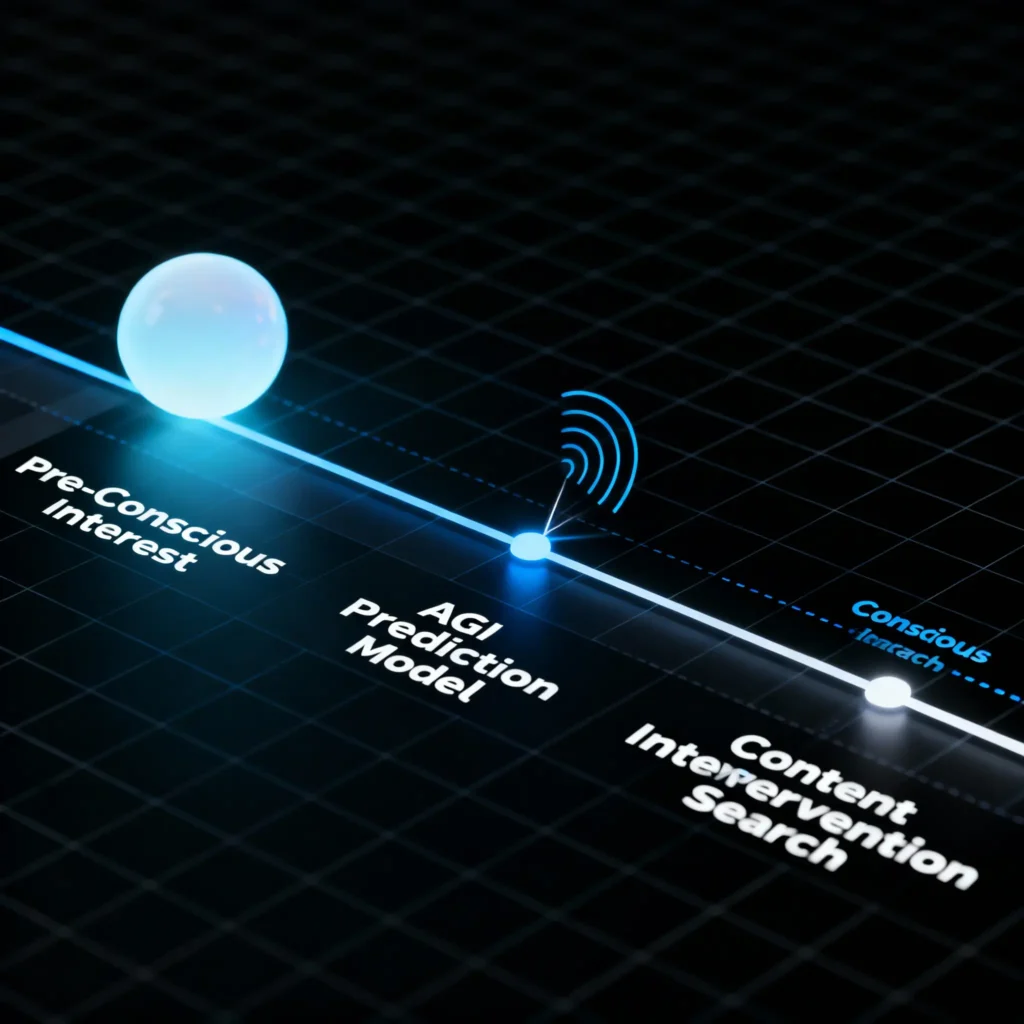
Part 1: The Psychology of Pre-Conscious Attention
Traditional marketing targets intent—a conscious desire for a product or information. Pre-conscious marketing targets interest—the vast, untapped reservoir of a user’s unconscious mind, where future needs and desires are formed.homeofdirectcommerce+1
- The 99% Rule: Research shows that 99% of our mental activity is unconscious. Our conscious mind determines our actions (like a search), but our unconscious mind determines our reactions and latent interests.outbrain
- The Power of Mirroring: Psychological studies reveal that consumers respond 3-5 times more positively to brands that seem to “get them” on a subconscious level—by mirroring their unspoken values, language, and latent interests.
An agentic AI doesn’t wait for a user to type “best eco-friendly sneakers.” It analyzes their browsing history, content consumption, and social signals, and concludes: “This user reads about climate change, follows sustainable influencers, and buys organic food. They have a high probability of developing an interest in eco-friendly apparel within the next 30 days.” The AGI then proactively places content about sustainable footwear in their discovery feeds.
Part 2: The ALFAIZNOVA AGI Attention Capture Framework
Agentic AI is not just predictive; it’s autonomous. It doesn’t just forecast a need; it takes action to capture the resulting attention. The ALFAIZNOVA framework is built on a five-layer stack that turns behavioral data into proactive marketing interventions.
| Layer | Function | How It Works |
|---|---|---|
| 1: Pre-Cognitive Signal Ingestion | The AGI continuously ingests trillions of data points: browsing history, content dwell time, scroll velocity, social media engagement, and even ambient data like location and time of day mailchimp+1. | This creates a deep, multi-dimensional profile of a user’s latent interests and unconscious affinities. |
| 2: Intent Prediction Modeling | Using advanced machine learning, the AGI models the “trajectory” of a user’s interest, predicting what topics they will become consciously interested in and when. | It answers the question: “What problem will this user need to solve in 7, 14, or 30 days?” |
| 3: Content-to-Intent Mapping | The AGI maps your entire content library to the predicted intents. It identifies which article, video, or ad is the perfect “intervention” for a specific predicted need. | This moves beyond keyword matching to true semantic and psychological alignment. |
| 4. Predictive Content Delivery | The AGI pushes the mapped content into the user’s discovery surfaces (Google Discover, Gemini Overviews, social media feeds) at the precise moment their latent interest is predicted to peak. | The user sees the content and thinks, “Wow, I was just thinking about this!” In reality, the AI predicted the thought before it fully formed. |
| 5: Engagement Feedback Loop | The AGI measures the user’s engagement with the delivered content. A positive interaction (a click, a long dwell time) validates the prediction and refines the model for the future. | This creates a self-improving system that gets progressively better at predicting and capturing attention. |
Part 3: The Step-by-Step Implementation Workflow
Deploying this framework requires a shift from a keyword-centric to a persona-centric content strategy.
Step 1: Build Deep Customer Personas
Go beyond demographics. Use your Blog Topic Idea Generator and customer data to map out the psychological profiles of your key segments. What are their unspoken values, fears, and aspirations?
Step 2: Map Content to Pre-Conscious Needs
For each persona, identify the latent needs that precede a conscious search.
- Persona: “First-Time Homeowner”
- Conscious Search: “best mortgage rates”
- Pre-Conscious Need: A feeling of being overwhelmed by the home-buying process.
- Content Intervention: An article titled “The First-Time Homebuyer’s Checklist: 5 Things to Do Before You Even Talk to a Lender.”
This type of “pre-intent” content, as described in our AI Marketing Automation Guide, captures users before they even know what to search for.
Step 3: Structure Content for AGI Ingestion
AGI models need highly structured, semantically rich content to work effectively.
- High Entity Density: Pack your content with relevant named entities (people, products, concepts).
- Clear Intent Signals: Use schema markup to explicitly define the purpose of your content.
- Optimized for Readability: Use your AI Content Readability Optimization techniques to ensure the content is easily digestible.
Step 4: Deploy Across Predictive Surfaces
Focus your distribution efforts on AI-driven discovery feeds:
- Google Discover
- Gemini Overviews
- TikTok “For You” Page
- Instagram “Explore” Page
Step 5: Monitor and Optimize for Attention Metrics
Forget keyword rankings. The new KPIs are Attention Metrics. Use your SEO Score Simulator and Keyword Trend Simulator to track:
- Discover Impressions: How often is your content being proactively shown?
- Discover CTR: What percentage of users click when it’s shown?
- Dwell Time: How long do they stay once they click?
Part 4: Real-World Case Study
- Brand: A high-end sustainable travel company.
- Old Strategy: Bidding on expensive keywords like “luxury eco-tourism.” (High CPC, low conversion).
- New AGI Attention Capture Strategy:
- The AGI identified a segment of users who were reading about climate change, minimalist lifestyles, and plant-based diets.
- It predicted a 75% probability that this segment would develop an interest in “impactful travel” within 60 days.
- It proactively delivered an article titled “Beyond the Resort: 5 Transformative Travel Experiences That Heal the Planet” to their Google Discover feeds.
- The Results:
- Traffic: 80,000+ clicks from Discover in the first month from users who had never searched for the brand or its keywords.
- Cost: $0 in ad spend.
- Conversion: The “pre-educated” audience converted at a 3x higher rate than traffic from paid search.
Conclusion
The battle for consumer attention is no longer won on the search results page. It’s won in the moments before a search even begins. The ALFAIZNOVA Attention Capture Framework provides the first systematic methodology for moving beyond reactive, keyword-based marketing and into the new world of proactive, pre-conscious prediction. Brands that master this will not just be marketing to their customers; they’ll be thinking with them. This is the future of our Omnichannel Marketing Playbook.
SOURCES
- https://homeofdirectcommerce.com/article/understanding-customer-intent-why-low-intent-users-matter-more-than-you-think/
- https://mailchimp.com/resources/intent-based-marketing/
- https://www.emerald.com/apjml/article/doi/10.1108/APJML-08-2024-1169/1250710/How-does-the-rise-of-eco-consciousness-shape?searchresult=1
- https://nbs.net/what-conscious-consumerism-really-means/
- https://www.outbrain.com/blog/intent-vs-interest-how-to-tap-into-the-unconscious-mind-of-consumers/
- https://dotdigital.com/blog/what-is-customer-intent-and-how-to-use-it-in-your-marketing/
- https://dovetail.com/customer-research/customer-intent/
- https://www.sciencedirect.com/science/article/pii/S2667096824000636